 By Sriram on March 24, 2026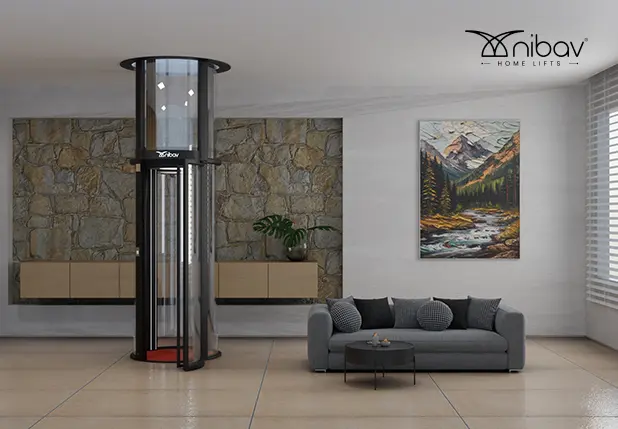
As houses become taller and families become bigger, the need for vertical mobility is no longer confined to commercial spaces. Whether you’re moving into a new home, renovating a duplex, or simply thinking ahead for your ageing parents, one thing is for sure: you have wondered whether to opt for a personal home elevator or a conventional elevator.
Both will transport you from one floor to another, but beyond that, there is a significant difference. Read on as we discuss every difference.
Table of Contents
▾- What Is a Personal Home Elevator?
- What Are Traditional Lifts?
- Personal Elevator vs Traditional Lift: Side-by-Side Comparison
- Why Are Personal Elevators Gaining Popularity Across India?
- When Should You Choose a Personal Home Elevator?
- Who Benefits Most from a Personal Home Elevator?
- How Does Pneumatic Technology Differ from Traditional Lift Mechanisms?
- Nibav Personal Elevators: Which Model Is Right for You?
- Frequently Asked Questions
- Conclusion: Which One Is Right for Your Home?
What Is a Personal Home Elevator?
A Personal Home Elevator is a small residential elevator designed for use inside a home without extensive construction. A personal elevator is not a large piece of machinery like a commercial elevator. A personal elevator is designed for residential use and is quiet, space-saving, and stylish.
Nibav’s personal elevators are air-driven pneumatic elevators. These use differences in air pressure to move the cabin smoothly between floors. There are no cables or counterweights, and no pit is required.
Nibav residential personal elevators:
- Series III – Compact personal elevator, 210 kg capacity, ideal for smaller homes
- Series IV – Personal elevators with superior design and safety features, including a large glass wall for a clear view
- Series V – Smart air-driven home elevator with advanced features and a compact, premium design.
- Series V Max – Air-driven home elevator with a larger cabin and enhanced accessibility for comfortable movement.
What Are Traditional Lifts?
Traditional lifts refer to the heavy-duty lifts commonly found in apartments, offices, and high-rise buildings. They are usually operated by hydraulic systems or traction-based systems. They require specialised equipment, a shaft, a deep pit, a machine room, and substantial civil construction work.
Though they are suitable for heavy-duty usage, the conventional lifts are often too large, over-engineered, and impractical for domestic use.
Personal Elevator vs Traditional Lift: Side-by-Side Comparison
| Feature | Personal Home Elevator(Nibav) | Traditional Lift |
| Primary Use | Residential homes | Commercial & high-rise buildings |
| Installation | No pit, shaft, or machine room needed | Requires pit, shaft & machine room |
| Technology | Air-driven pneumatic system | Hydraulic or traction-based |
| Space Requirement | Compact & space-efficient | Large dedicated space required |
| Design | Panoramic, modern, customizable | Functional, minimal design focus |
| Capacity | 2–4 persons (approx. 210–240 kg) | Higher capacity for heavy usage |
| Energy Use | Zero power during descent | High energy consumption |
| Maintenance | Low — fewer moving parts | Higher — complex mechanical systems |
| Installation Time | A few days | Weeks to months |
| Best For | Villas, duplexes, independent homes | Apartments, offices, high-rises |
Why Are Personal Elevators Gaining Popularity Across India?
The rising demand for personal elevators is no surprise. There are several reasons for this, including:
Vertical living is the new normal. The lack of land space has forced people to build vertically. Multi-storey villas and duplexes have become the new normal for places such as Chennai, Bengaluru, Hyderabad, and Mumbai.
Multi-generational families require more efficient solutions. The typical Indian home consists of grandparents, parents, and kids under one roof. The Personal Home Elevator is perfect for such families.
Space is a luxury. Unlike conventional elevators, personal elevators such as the Series III have been designed to fit into existing home spaces with minimal floor space.
Convenience is essential. From transporting groceries to moving household items, a personal elevator offers significant ease and practicality in daily living.
When Should You Choose a Personal Home Elevator?
A Personal Home Elevator is an excellent choice if:
- You have a multi-storey home of two or more floors.
- You want a solution that doesn’t require major alterations to your home.
- You need a solution for elderly or differently abled family members.
- You want a sleek, compact design that fits in with your home decor.
- You’re looking for a long-term solution for your home.
The Series IV Max features a larger cabin and more comfort with wheelchair access, making it an excellent choice for accessibility-focused families.
Who Benefits Most from a Personal Home Elevator?
This is particularly beneficial for elderly family members, as they can easily move from one floor to another. For families with young children, it is more convenient for them, especially when they carry kids and strollers.
For persons living with disabilities, they can access each floor of the house easily and safely. For future-thinking homeowners, they will not only be adding value to their homes but also future-proofing their homes.
How Does Pneumatic Technology Differ from Traditional Lift Mechanisms?
Traditional lifts have a complex system of cables, pulleys, counterweights, and hydraulic systems, which need to be serviced and, eventually, replaced.
Nibav’s pneumatic personal elevators, on the other hand, have a very different mechanism. The pneumatic personal elevator moves up using air pressure and descends slowly due to the release of air. The advantages of pneumatic personal elevators include:
- Fewer moving parts mean less maintenance.
- Smooth, stable, and whisper-quiet performance
- No energy consumption when going down
- Self-supporting structure, no need for a shaft or pit
This makes pneumatic personal elevators not just more user-friendly but also more energy-efficient compared to traditional lifts.
Nibav Personal Elevators: Which Model Is Right for You?
- Series III Standard – Best suited for compact homes and tight spaces. 210 kg capacity. Minimum footprint, maximum functionality.
- Series IV – The next big step in terms of design and technology. Panoramic cabins for maximum comfort and safety.
- Nibav Series V : SmartConnect™ integration, VividTouch™ display, refined interiors, and intuitive controls. Designed for seamless performance, everyday comfort, and a smarter lift experience.
- Nibav Series V Max : SmartConnect™ integration, expanded cabin space, premium finishes, and complete customisation. Built for Indian homes that refuse to compromise on space, luxury, and performance.
Frequently Asked Questions
1. What is the main difference between a Personal Home Elevator and a normal lift?
Personal Home Elevator is designed specifically for home use. It is compact, easy to install, and blends well into the home environment. Normal lifts are industrial-strength equipment designed for use in commercial buildings and skyscrapers.
2. Are personal home elevators suitable for homes in India?
Yes, personal home elevators are highly suitable for homes in India. With multi-storey living becoming increasingly common, homeowners require solutions that prioritise space optimisation, accessibility, and ease of installation. Residential home elevators are designed to fit compact spaces, enhance mobility for all age groups, and can be installed with minimal disruption—making them an ideal choice for Indian households.
3. Do personal home elevators require construction?
No. Most Personal Home Elevators, including the entire range of Nibav Personal Home Elevators, do not require a pit, shaft, or machine room. They are installed in 24-48 working hours.
4. Are Elevators safe for home use?
Yes. At Nibav, our Personal Home Elevators are equipped with emergency descent systems, stable pneumatic systems, and secure cabin locking systems. These are designed specifically for home use.
5. How energy-efficient are personal home elevators?
Very. At Nibav, our Personal Home Elevators only draw power when going up. When going down, the descent is powered solely by the controlled release of air. No power is consumed when going down.
Conclusion: Which One Is Right for Your Home?
While traditional lifts are designed for volume and commercial usage, Personal Home Elevators are designed for you.
Are you a homeowner of a villa, duplex, or multi-storey home in India? Do you want a product that can be installed quickly, fits into your space, and matches your style and design requirements? If you want a product that will serve your family for generations to come, then a Personal Home Elevator is the answer for you.
At Nibav, we have designed a range of Personal Home Elevators from the compact and feature-rich Series III to the luxurious and high-tech Series V Max. It is not just an investment in a personal elevator; it is an investment in a home that works for you and your family.