 By shanmugapriya on April 27, 2026
|
By shanmugapriya on April 27, 2026
|



Indoor vs Outdoor Home Elevators: Which Is Better for Indian Homes? Cost, Design & Durability Compared
As home lifts become increasingly mainstream across Indian cities, a new decision point is emerging for homeowners: should the elevator go inside the home or outside? Both configurations have genuine merits, and both have real limitations depending on your property type, architecture, and budget.
If you are considering an indoor vs. outdoor home elevator for your Indian home in 2026, this guide will walk you through every dimension that matters, from cost and durability to aesthetics and suitability for Indian weather conditions.
The rise of compact vacuum elevators and pneumatic lift technology has made this decision more nuanced than ever. Unlike traditional elevators that are almost exclusively interior installations, pneumatic home lifts can, in some configurations, be adapted for covered exterior spaces.
Understanding where the pneumatic elevator fits within this comparison, and why it remains the most versatile and practical solution for Indian residential properties, is the starting point for making the right choice.
Table of Contents
▾- What Is an Indoor Home Elevator?
- What Is an Outdoor Home Elevator?
- Cost Comparison: Indoor vs. Outdoor Home Elevators in India
- Durability in Indian Conditions: The Critical Factor
- Design and Aesthetics: Which Looks Better in Indian Homes?
- Which Homes Are Best Suited for Each Type?
- The Nibav Advantage: Why Indoor Pneumatics Is the Right Choice
- Frequently Asked Questions
What Is an Indoor Home Elevator?
An indoor home elevator is installed within the interior of your house, typically in a corner of the living room, near the staircase, or in a dedicated space carved out from an existing room. Indoor elevators are integrated into your home’s existing architecture.
They benefit from shelter from weather elements, consistent temperature, and seamless alignment with your interior design language. In the Indian context, where dust, humidity, and monsoon rains are persistent challenges, indoor installation offers significant practical advantages for the lift’s mechanical components.
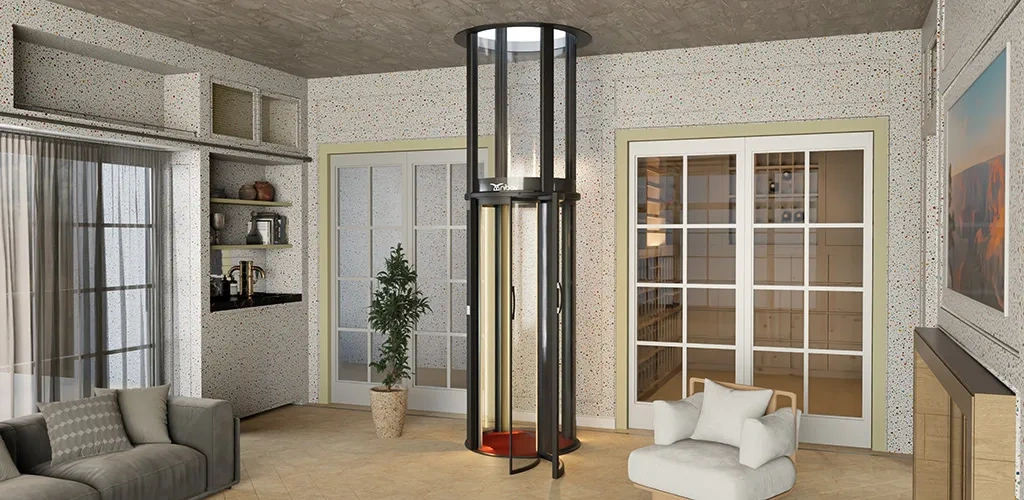
Nibav’s pneumatic home lifts are primarily designed for indoor installation and excel in this environment. The transparent panoramic cylinder becomes a design feature that enhances your interior.
The compact footprint, requiring as little as 1 square metre, means even smaller homes can accommodate the lift without sacrificing meaningful living space. And the 24- to 48 working hour installation means your home is minimally disrupted throughout the process, a key advantage for families living on-site during installation.
What Is an Outdoor Home Elevator?
An outdoor home lift in India is installed on the exterior facade of a building, typically attached to an exterior wall or within a covered outdoor space such as a veranda or carport.
Outdoor lifts are common in European and North American climates where properties are designed with accessible exterior entrances. Outdoor home lift installations in India are less common but are seen in large independent bungalows, farmhouses, and commercial villas where internal space constraints make exterior placement more practical.
Outdoor home lifts in India face specific challenges that buyers must evaluate carefully. Exposure to monsoon-level humidity, intense summer heat (especially in cities like Chennai, Hyderabad, and Ahmedabad), airborne dust, and UV radiation all accelerate mechanical wear and require more rigorous maintenance schedules.
Any outdoor lift installation must incorporate weather-resistant enclosures, corrosion-treated components, and sealed electrical systems to perform reliably year-round in Indian conditions.
Cost Comparison: Indoor vs. Outdoor Home Elevators in India
| Cost Factor | Indoor Elevator | Outdoor Elevator |
| Base installation cost | INR 11.49–26 lakhs (Nibav range) | INR 12–25 lakhs+ |
| Civil/structural work | Minimal with Nibav | Significant (weather enclosure, foundation) |
| Annual maintenance | Lower (sheltered environment) | Higher (weather exposure) |
| Durability (Indian climate) | Excellent | Moderate to Good (needs weatherproofing) |
| Design integration | Seamless interior aesthetic | Architectural modification required |
| Installation timeline | 24–48 working hours (Nibav) | Several weeks |
| Monsoon impact | Zero | Significant risk without proper sealing |
Durability in Indian Conditions: The Critical Factor
How Indian Weather Affects Outdoor Elevators
India’s climate presents some of the world’s most demanding conditions for mechanical equipment. The monsoon season brings 3 to 4 months of high humidity, standing water, and persistent moisture that accelerates rust, corrosion, and electrical degradation.
Summer temperatures in many Indian cities regularly exceed 40 degrees Celsius, causing thermal stress on metal components, rubber seals, and motor windings. Any outdoor elevator must be engineered specifically for these conditions, and maintenance budgets must reflect the additional wear these elements cause.
Why Indoor Pneumatic Elevators Outperform Outdoors in India
Nibav’s vacuum elevator, positioned indoors, is entirely shielded from these climatic challenges. The polycarbonate or glass cylinder, the air pump unit, and all electrical components operate in the controlled environment of your home.
This dramatically extends component lifespan, reduces maintenance frequency, and ensures consistent performance year-round regardless of whether Chennai experiences a 45-degree heat wave or a monsoon deluge. For Indian homeowners prioritising long-term value, indoor installation is the clear winner.
Design and Aesthetics: Which Looks Better in Indian Homes?
From a design perspective, indoor elevators offer far greater integration potential with Indian home interiors. The Nibav panoramic glass cylinder becomes an architectural showpiece, visible from the living area and adding a sense of vertical openness and luxury.
Indian homes with open-plan layouts, double-height living rooms, and premium finishes are perfectly complemented by a sleek pneumatic lift that draws the eye and sparks conversation among guests.
Outdoor elevators, while functional, often appear as afterthoughts attached to a building’s exterior. They require careful architectural planning to avoid appearing incongruous with the home’s facade.
In gated communities and apartment complexes governed by homeowner association rules, outdoor elevator additions may face regulatory resistance. For most urban and semi-urban Indian homeowners, the indoor elevator is the aesthetically superior and practically superior choice.
Which Homes Are Best Suited for Each Type?
Best Candidates for Indoor Home Lifts
- 2 BHK and 3 BHK duplex apartments
- Independent two-storey and three-storey houses
- Compact villas and row houses
- Homes with elderly or mobility-challenged residents
- Properties seeking a luxury lifestyle upgrade
Best Candidates for Outdoor Home Lifts
- Large farmhouses with expansive exterior spaces
- Heritage or character homes where interior modification is restricted
- Commercial villas with exterior covered verandas
- Properties where the internal floor plan cannot accommodate any lift footprint
Which Nibav Model Is Right for Your Home?
Choosing the right home elevator also depends on your space, family size, and usage needs. Nibav offers multiple pneumatic home lift models designed to suit everything from compact 2 BHK homes to larger villas.
Here’s a quick comparison:
Nibav Home Lift Models – Quick Comparison
| Model | Type | Capacity | External Diameter | Best For |
| Series III Standard | Standard | 2 persons | ~935 mm | Compact homes |
| Series III Max | Max | 3–4 persons | ~1343 mm | Families |
| Series IV Standard | Standard | 2 persons | ~933 mm | Modern homes |
| Series IV Max | Max | 3–4 persons | ~1363 mm | Spacious homes |
| Series V Standard | Standard | 2 persons | ~933 mm | Smart homes |
| Series V Max | Max | 3–4 persons | ~1363 mm | Larger smart homes |
How to Choose for Indoor vs Outdoor Decision
- For indoor installations (recommended in India)
→ Series III or Series IV works best for compact homes
→ Max variants if you need more space or accessibility - For covered outdoor setups (rare cases)
→ Only larger models with proper enclosure planning
The Nibav Advantage: Why Indoor Pneumatics Is the Right Choice
Nibav Home Lifts are engineered specifically for the Indian residential context. The decision to focus on indoor pneumatic elevator technology reflects a deep understanding of Indian home layouts, climate realities, and homeowner priorities.
No pit, no shaft, no machine room, and 24 to 48 working hour installation make the Nibav lift the most practical and least disruptive home elevator solution available in India today. The combination of world-class engineering, global certifications (ISO and TUV), and localised installation expertise makes it the benchmark product in its category.
When you choose Nibav, you are not simply purchasing a lift. You are investing in a product that has been validated across multiple countries and climates, installed in thousands of homes globally, and refined through continuous engineering innovation.
The single-phase power requirement, battery backup for power cuts, and automatic emergency descent are all designed with Indian homeowners’ daily realities firmly in mind. This is future-ready home mobility at its most intelligent.
Considering a Home Lift? Book Your Free Nibav Site Assessment and See the Difference for Yourself.
Frequently Asked Questions
1. Can an outdoor home elevator survive Indian monsoons?
Outdoor home lifts can survive monsoons if they are properly weather-proofed with IP-rated enclosures, sealed electrical systems, and corrosion-resistant materials. However, maintenance costs are significantly higher, and the risk of component degradation is greater than with indoor installations.
2. How much does an indoor home elevator cost in India compared to an outdoor one?
Indoor pneumatic lifts from Nibav typically start at around ₹11–15 lakhs, depending on the model and customization. Outdoor installations generally cost more due to additional requirements like weatherproofing, structural reinforcement, and protective enclosures, with prices usually ranging from ₹18–20+ lakhs or higher.
3. How fast can Nibav install an indoor home elevator?
Nibav completes indoor installation within 24 to 48 working hours. This is made possible by the modular, pre-fabricated design that requires no civil construction, no pit digging, and no machine room.
4. Does an indoor Nibav lift require changes to my walls or floor?
No. Nibav’s pneumatic lift is a self-supporting modular unit that stands independently without needing to be anchored into your walls or floor. It requires only a suitable footprint of approximately 1 square metre and a connection to your standard single-phase electricity supply.
5. Is Nibav available across India?
Yes. Nibav Home Lifts has a nationwide presence across India with 40+ experience centres in major cities including Chennai, Bengaluru, Mumbai, Delhi, Hyderabad, and Coimbatore. Site assessments and installations are available across India.
Author
 Sriram
I'm Sriram, part of the Research & Development team. I specialize in home lift technology, working closely on innovations that make our elevators safer, more efficient, and better suited for modern homes. My role involves everything from testing new features to fine-tuning the performance of our latest lift models.