 By shanmugapriya on May 11, 2026
|
By shanmugapriya on May 11, 2026
|



Home Lift vs Staircase: Detailed Safety Comparison for Families, Elderly & Children
A single missed step. A slight loss of balance. That’s all it takes for a staircase to turn from a daily routine into a life-changing accident.
In many Indian homes, stairs are used without a second thought. They’ve always been there, quietly connecting floors, blending into everyday life. But as families grow and needs evolve, so does the reality around them. Elderly parents begin to slow down, children move unpredictably, and routine tasks like carrying groceries or luggage start to feel physically demanding.
At that moment, a critical question emerges—one most families delay asking:
Is a staircase still the safest option for your home?
This is where the discussion of home lift vs staircase shifts from convenience to something far more important—safety, accessibility, and long-term peace of mind.
Table of Contents
▾What is safer: a home lift or a staircase?
A home lift is significantly safer than a staircase because it eliminates fall risks, reduces physical strain, and provides a controlled, enclosed movement system—especially for elderly individuals and children.
Across households, one pattern repeats itself—stairs are ignored until they become a problem.
Globally, falls are among the leading causes of home injuries, particularly for individuals above 60. In multi-floor homes, staircases are one of the most common risk zones. The reasons are simple but serious—reduced balance with age, joint pain, fatigue, poor lighting, and the added difficulty of carrying items while climbing.
For children, the risks take a different form. Stairs become a place of speed and play. A small slip or misjudged step can lead to injuries that could have been easily avoided.
The reality is straightforward:
stairs demand physical effort, coordination, and constant attention every single time they are used.
Home Lift vs Staircase: Quick Safety Comparison
| Factor | Home Lift | Staircase |
| Fall Risk | Minimal | High |
| Elderly Accessibility | Effortless | Physically demanding |
| Child Safety | Enclosed and controlled | Open and unpredictable |
| Physical Effort | None | Continuous strain |
| Daily Convenience | High | Moderate |
| Long-term usability | Future-ready | Limited |
This comparison clearly highlights why more families today are actively evaluating home lift benefits vs stairs not as an upgrade—but as a necessity.
Why are stairs risky for elderly people?
Stairs increase the risk of falls due to reduced stability, slower reflexes, and physical strain, making them one of the most dangerous areas in a multi-floor home for elderly individuals.
But safety is not just physical—it’s deeply emotional.
An elderly parent quietly avoids the upper floor because climbing feels exhausting. A child being constantly warned not to run on the stairs. A moment of hesitation every time something needs to be carried upstairs.
These are not just small inconveniences. They are signs that your home is slowly becoming restrictive.
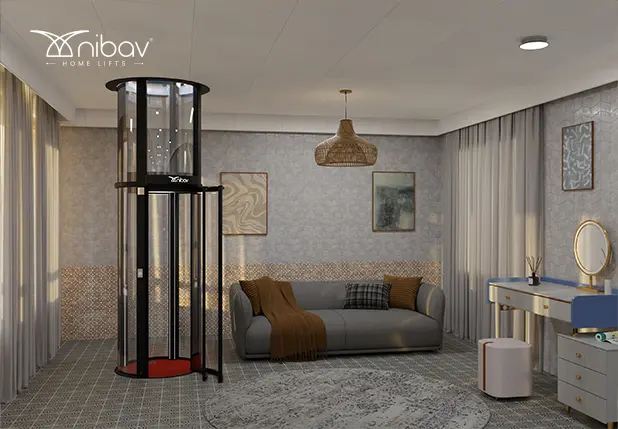
A home should adapt to your family—not the other way around. A glass lift changes this dynamic completely.
It removes effort from movement. It replaces uncertainty with control. It transforms vertical travel into something smooth, safe, and predictable.
With Nibav Home Lifts India, this transformation is designed specifically for residential environments. Their lift solutions are engineered to integrate seamlessly into homes without requiring major structural changes, making them practical for both new and existing spaces.
Instead of climbing, balancing, and straining, movement becomes effortless and secure.
Are home lifts safe for children?
Yes, home lifts are designed with enclosed cabins, controlled movement, and advanced safety mechanisms, making them significantly safer than staircases for children.
Why Safety with Nibav India Goes Beyond Just Design
When comparing home lift vs staircase, safety should not rely on assumptions—it should be backed by proof.
This is where Nibav Home Lifts India distinguishes itself through globally recognized certifications.
The company is certified under TUV , ensuring consistent quality management and reliable performance across every installation. This means homeowners receive a product that meets strict quality benchmarks.
With ISO 45001:2018, Nibav ensures that every unit is produced under strict occupational health and safety standards, maintaining high levels of operational safety.
At the product level, the TÜV NORD certification for its standard model confirms compliance with European safety standards—one of the most demanding benchmarks globally.
For homeowners, this translates to confidence.
You’re not simply installing a lift—you’re choosing a system that is tested, validated, and built with safety at its core.
Choosing the Right Lift for Your Home
Every home is different, and so are its requirements.
This is why Nibav Home Lifts India offers a range of solutions tailored to different needs.
For compact homes, the Series III Standard offers a space-saving lift solution, while the Series III Max provides a larger, more premium option with enhanced comfort and capacity.
For families focused on improving accessibility for elderly members, the Series IV and IV Max provide enhanced usability and comfort.
For homeowners looking for advanced features and refined design, Series V and V Max deliver a premium experience with superior engineering and safety integration.
Each model is designed with the same core philosophy—making everyday movement safer and more accessible for every member of the family.
Problem to Solution: The Shift That Changes Everything
Staircases expose families to daily risks—falls, fatigue, and long-term strain. Over time, they limit independence and create hesitation in movement, especially for elderly individuals.
The solution is equally clear.
A home lift eliminates these risks, offering a safe, reliable, and effortless way to move between floors.
With Nibav Home Lifts India, this transition is not just about convenience—it’s about transforming how your home supports your lifestyle.
Is a home lift worth it compared to stairs?
Yes, a home lift is worth it because it improves safety, enhances accessibility, and ensures your home remains functional and comfortable for years to come.
When Should You Make the Switch?
The right time to make this decision is not after an accident—it’s before one happens.
If your home includes elderly parents, growing children, or frequent movement between floors, relying only on stairs introduces a level of risk that can be avoided.
Planning ahead is not an expense—it’s a responsibility.
Beyond Safety: A Smarter Way to Live
While safety is the primary driver, the benefits of a home lift extend far beyond that.
It simplifies daily routines, reduces physical effort, and enhances the overall usability of your home. It also adds long-term value by making the property more accessible and future-ready.
Most importantly, it creates a living environment where every family member—regardless of age—can move freely and confidently.
Don’t Wait for a Fall to Make This Decision
Most families only consider alternatives after an incident occurs.
A staircase doesn’t warn you before it becomes dangerous. But the solution is already within reach. Choosing a home lift today is a proactive step toward safety, comfort, and long-term peace of mind.
Take Action Now—Because Safety Shouldn’t Be Delayed
If you’re still evaluating home lift vs staircase, the answer is clear.
A staircase is a necessity. A home lift is a safety upgrade your family deserves.
Explore certified and safety-focused solutions from Nibav Home Lifts India and take the next step toward creating a safer, more accessible home. Don’t wait for an accident to make this decision. Act now and protect what matters most.
Frequently Asked Questions
1. Which is safer: home lift or staircase?
A home lift is safer because it eliminates fall risks and provides controlled movement, making it ideal for elderly individuals and children.
2. Are home lifts safe during power cuts?
Yes, Nibav home lifts are designed with safety features that allow controlled descent or safe operation during power interruptions.
3. Do home lifts require major structural changes?
No, Nibav home lifts are designed for easy installation with no structural modifications, making them suitable for existing homes.
4. Can children use home lifts safely?
Yes, Nibav home lifts are safer for children due to enclosed cabins and controlled operation with easy controls, reducing the risk of accidents.
5. Is installing a home lift a good investment?
Yes,Nibav lifts improve safety, accessibility, and property value, making it a practical long-term investment.