
 By shanmugapriya on August 17, 2026
|
By shanmugapriya on August 17, 2026
|



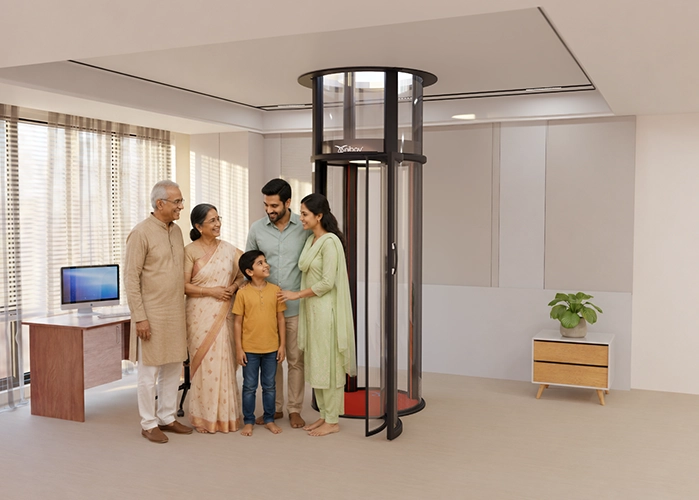
Home Elevator Case Study: How a Nibav Residential Lift Solved Accessibility Challenges for an Indian Family
Every home elevator case study in India starts the same way: not with a product, but with a staircase somebody can no longer climb.
At Nibav Home Lifts we have surveyed thousands of Indian homes, and the conversation almost always begins after a fall, a surgery, or a quiet decision that a parent should stop using the stairs.
For the family in this case study, in a three-floor independent house in Chennai, it began the week their 68-year-old father came home from knee replacement surgery.
At first they improvised, the way most Indian families do. His bed moved to the ground-floor guest room while his cupboard stayed upstairs.
The second-floor prayer room he had visited every morning for thirty-one years became a place he only heard about. His wife carried wet laundry three floors to the terrace alone, twice a day.
Their daughter began sleeping lightly, listening for the sound of her father attempting the stairs at night when nobody was watching.
That is the part families rarely say out loud. A staircase does not just restrict movement, it slowly redraws who is allowed to belong in which parts of their own home. Ramps cannot solve vertical floors. Moving to an apartment means abandoning a house built over three decades.
Their marble staircase was too narrow for a stair lift, and a conventional elevator meant demolition. What they installed instead was a Nibav air-driven home lift, and this residential lift case study sets out exactly how that decision was made, what our survey found, and what changed afterwards.
Table of Contents
▾- Who This Nibav Case Study Is For ?
- The Problem: When a Staircase Becomes a Daily Barrier
- Inside the Residential Lift Case Study: The Family’s Brief to Nibav
- Home Lift Accessibility, Solved: Why the Family Chose Nibav
- What Changed Six Months After the Nibav Installation
- Why Families Across India Choose Nibav Home Lifts
- Book a Nibav Home Lift Demo Near You
- Frequently Asked Questions
- 1. Can a Nibav home elevator be installed in an existing house without breaking the staircase?
- 2. How much space does a Nibav home lift need in a typical Indian home?
- 3. Is a Nibav home lift safe for elderly parents to use alone?
- 4. What happens in a power failure while someone is inside?
- 5. How long does a Nibav home elevator installation take?
- 6. Does a home lift add value when selling the house?
Who This Nibav Case Study Is For ?
If you are in your late thirties to mid-fifties, own an independent house or duplex, and have quietly started researching because a parent is slowing down, this is written for you.
It is also for homeowners over 60 who have been advised to stop climbing stairs, and for NRIs trying to make a parent’s home in India safer from another time zone.
Nobody in this group is shopping for machinery. They are looking for a way to stop worrying, and that is the problem we design around.
The Problem: When a Staircase Becomes a Daily Barrier
Indian homes are built vertically. A 30×40 plot with three floors is far more common than a wide single-storey layout, which means the average independent house asks its occupants to climb between 40 and 80 steps a day simply to live normally. That design works beautifully at 40 and turns hostile at 70.
The pressure points this family listed are ones our survey teams hear in almost every Indian city:
- The prayer room and terrace were on upper floors, making them effectively off-limits
- The staircase was steep, marble-finished and slippery through the monsoon
- Two residents were over 65, one with a cardiac restriction on exertion
- Grandchildren visited at weekends, so the ground floor was never private
- There had already been one near-fall on the landing, which the family described as their turning point
Home elevators accessibility, in other words, was not a luxury question. It was a question about whether two people could keep living in the house they built, without supervision and without the whole family reorganising itself around a flight of stairs.
Inside the Residential Lift Case Study: The Family’s Brief to Nibav
Before looking at any product, this family wrote down their constraints. It was the most useful hour of the entire project, and it is the step we now encourage every customer to take before we visit.
- No civil demolition. The staircase, marble flooring and load-bearing walls had to stay untouched.
- No separate machine room. There was no spare utility space to give up.
- A footprint compact enough to sit beside the existing staircase without blocking circulation.
- Safe behaviour during power cuts, still frequent in their area through summer.
- Installation in days, not months, because both parents would live in the house throughout.
- Something that looked like furniture, not hospital equipment. This mattered far more than the family expected.
With that list in hand the shortlist narrowed fast. Traction elevators were ruled out on structural grounds. Hydraulic units needed a pit and a machine room. A stair lift failed the width test and, as their daughter put it, made her father feel like a patient in his own home. What remained was the category Nibav has spent years engineering for: a self-supporting, air-driven vacuum lift that stands on the existing floor slab.
Home Lift Accessibility, Solved: Why the Family Chose Nibav
Our technical survey took a single visit. The team measured floor-to-floor height at each level, checked the slab’s load capacity, confirmed a single-phase power point within reach, and marked a position beside the staircase using a corner the family had been filling with potted plants for a decade.
Three decisions ended up mattering most, and none of them was about the machine’s specification.
- Placement over specification
We positioned the lift so it opened directly onto the landing outside the first-floor bedroom, and a few steps from the second-floor prayer room. A technically identical lift installed six feet to the left would have solved half the problem. This is the single biggest difference a Nibav site survey makes.
- Controls designed for arthritic hands
Large, well-lit controls at a reachable height with clear confirmation. A small detail with a disproportionate effect on whether an elderly user operates the lift independently or waits for somebody to help.
- A panoramic cabin
The family first assumed the 360-degree glass cabin was cosmetic. In use it became the reason he stopped feeling anxious about enclosed spaces, and the reason his wife could see him from the hall while he travelled. Visibility is a safety feature in an elderly household, not a styling choice.
Installation took a matter of days, with no wall breaking, no pit excavation and no need for the family to move out of the house.
What Changed Six Months After the Nibav Installation
We asked the family to describe the outcome without using the word convenient. Their answers were more practical than any brochure line we could write:
- He moved back into his own first-floor bedroom within a week of installation.
- He resumed his morning routine in the second-floor prayer room, unaccompanied.
- Laundry, water cans and groceries stopped being a two-person job.
- The night-time anxiety about someone attempting the stairs alone disappeared, which their daughter called the real return on the investment.
- Running cost stayed comparable to a household appliance, because an air-driven lift draws power only on the way up and descends without a motor.
There was one outcome we did not plan for. Two neighbours on the same street enquired within four months, both in an almost identical situation. Accessibility problems cluster in neighbourhoods built at the same time by people of roughly the same age, which is why so much of our work in Chennai arrives by referral rather than advertising.
Why Families Across India Choose Nibav Home Lifts
Nibav Home Lifts was built in India, for Indian homes that already exist. That single design constraint explains most of what makes our lifts different from imported elevator systems designed around new construction:
- Air-driven vacuum technology with a self-supporting structure, so no shaft, no pit, no lift well and no machine room
- A compact footprint that fits stairwell voids, hall corners and balcony-adjacent positions in tight urban plots
- Single-phase domestic power, with a controlled automatic descent to the lower floor if the supply fails
- Installation measured in days, with minimal dust and no structural demolition in an occupied home
- 360-degree panoramic cabins in finishes chosen to sit inside a home’s interiors rather than fight them
- No oil, grease or lubrication in the drive system, which keeps maintenance light and the machine clean
- Experience centres and trained service teams across Indian cities, so support does not depend on an engineer flying in
For families weighing a residential lift for elderly parents, the useful question is not which lift is best in the abstract. It is which lift your house can actually accommodate without being rebuilt. A Nibav site survey answers that in under an hour.
Book a Nibav Home Lift Demo Near You
Most families decide only after standing inside a cabin and operating it themselves, and elderly parents in particular tend to move from resistance to enthusiasm in about ninety seconds of doing so. Nibav operates experience centres and service teams across major Indian cities, so whether you are searching for Nibav home lifts in Chennai, home lift installation in Bengaluru, a residential elevator company in Hyderabad, or home lifts in Coimbatore, Kochi, Pune, Mumbai, Delhi NCR, Ahmedabad or Madurai, there is a Nibav team within reach.
Two things worth asking for when you get in touch:
- A free site feasibility survey at your home, with measurements and a placement recommendation in writing
- A demo with the family member who will use the lift most, not only the person paying for it
Bring your own version of this family’s list. The clearer your constraints, the faster we can tell you whether a Nibav home lift is right for your house.
Frequently Asked Questions
1. Can a Nibav home elevator be installed in an existing house without breaking the staircase?
Yes. Nibav lifts are self-supporting and stand on the existing floor slab, so no shaft, pit or machine room is needed and the staircase, flooring and load-bearing walls usually stay untouched. Our survey confirms slab suitability and floor-to-floor height before anything is ordered.
2. How much space does a Nibav home lift need in a typical Indian home?
Our compact models are designed for small footprints, which is why stairwell voids, hall corners and balcony-adjacent positions are the most common locations we install in 30×40 and 30×50 plots. Headroom at the topmost stop is usually the binding constraint rather than floor area, and the survey confirms both.
3. Is a Nibav home lift safe for elderly parents to use alone?
That is the design goal. Large reachable controls, a panoramic cabin with clear visibility, door interlocks that prevent movement unless doors are fully closed, an emergency alarm, and controlled automatic descent if power fails. At handover we train every regular user, including elderly family members, rather than only the person who signed the order.
4. What happens in a power failure while someone is inside?
Our air-driven lifts are designed to descend gently to the lower floor and release the door when power is lost, so nobody stays trapped between floors. We demonstrate this live during handover so the household has seen it happen once before it ever matters.
5. How long does a Nibav home elevator installation take?
Typically a matter of days for a two or three-stop configuration once the unit is on site, with no need for the family to vacate. Conventional shaft-based elevators retrofitted into an existing house can take several weeks and involve civil work.
6. Does a home lift add value when selling the house?
In multi-floor independent homes it widens the buyer pool to include older buyers and joint families, and it makes upper floors genuinely usable year-round. Most of our customers cite daily usability rather than resale as the deciding factor

Kavitha Srinivasan
This was a very helpful case study because it explains how a home lift can solve real accessibility issues for an Indian family. I especially liked the practical discussion around space, installation and elderly users. Anyone comparing a 4 person lift for home should also consider usability and safety along with the 4 person lift price before making a decision.
Shalini Mohan
A useful and realistic article for families considering a residential lift. The example shows that choosing a lift is not only about the 4 passenger lift price, but also about how well it fits an existing home and supports elderly family members. The points about installation without major structural changes make this blog especially informative for homeowners exploring a 4-person home lift in India.
Gayathri Subramanian
I found this case study quite informative because it focuses on an actual family situation rather than only discussing product features. The explanation of accessibility, staircase limitations and everyday convenience was easy to understand. For homeowners researching the cost of a 4 person lift, this article is a good reminder to compare space requirements, safety features and long-term practicality before deciding.
Janani Krishnamurthy
This blog gave me a much clearer idea of what families should evaluate before installing a home elevator. I liked how it connected mobility challenges with everyday activities instead of treating a lift simply as a luxury addition. People checking the 4 person elevator price should also look at installation requirements, maintenance and the available space to understand the overall lift cost for 4 persons.
Preethi Chandrasekar
A genuinely helpful read for anyone thinking about adding a lift to an existing Indian home. The family example makes the accessibility challenge easy to relate to, especially when elderly parents find stairs difficult after surgery or with age. It also highlights why the 4 person lift price should not be the only deciding factor when comparing a 4 person lift for home.
Revathi Balakrishnan
The practical approach in this article makes it different from typical home elevator content. I appreciated the explanation of how placement, cabin design and ease of use can affect an elderly person's independence. Families researching a 4-person home lift in India can use these points when comparing models, understanding the cost of a 4 person lift and deciding which option suits their home's layout.