 By shanmugapriya on July 10, 2026
|
By shanmugapriya on July 10, 2026
|


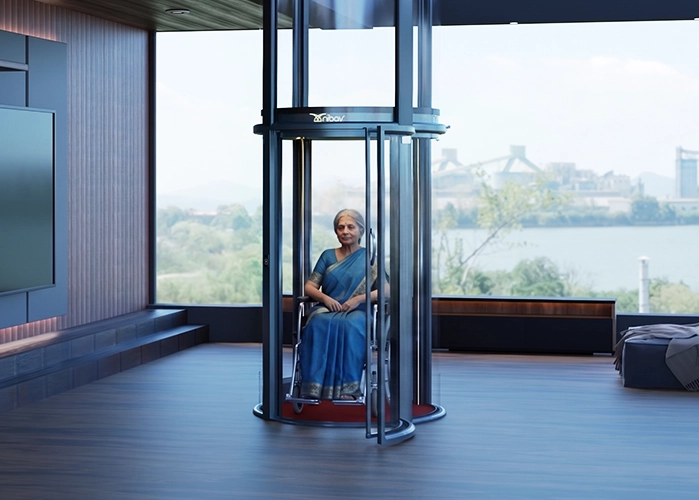
Best Villa Lifts in India for Luxury Homes | Premium Home Elevators
India’s villa market has matured. The homes being built and bought today in Bengaluru’s Whitefield, Hyderabad’s Jubilee Hills, Chennai’s ECR corridor, and Mumbai’s Alibaug outskirts are no longer just large — they are architecturally considered, luxury-specified, and built for a 30-year horizon.
In that context, a villa lift is no longer a retrofit discussion. It’s a design decision made at the planning stage, alongside the choice of stone, ceiling height, and facade material.
This guide is for that decision — and for homeowners who missed it at planning and want to make it now.
Table of Contents
▾- What Separates a Good Villa Lift from a Great One
- The Most Popular Villa Lift Configurations in India
- Why Air-Driven Lifts Dominate the Indian Villa Market
- The Features That Matter Most for Indian Villa Buyers
- Nibav Villa Lifts: Full Range
- Frequently Asked Questions
- 1. Which is the best lift brand for villas in India in 2026?
- 2. What is the most popular lift configuration for Indian villas?
- 3. How long does it take to install a villa lift in an existing home?
- 4. Can a villa lift be customised to match my interior design?
- 5. Is a home lift in a villa Vaastu compliant?
What Separates a Good Villa Lift from a Great One
The difference rarely comes down to technology. It comes down to three things that most buyers don’t think to ask about.
- Integration: Does it look like it was designed for your villa, or installed into it? A great home lift is flush with the architectural language of the space — not a standard product dropped into a custom home.
- Service network: A villa is typically in a premium or suburban location. A lift brand with 40+ experience centres and 500+ technicians across India means someone is nearby when you need them. A brand without that network means uncertainty.
- Warranty depth: You’re making a 20-year decision. A 25-year motor and seal warranty signals that the manufacturer has made the same commitment you have. A 1–2 year warranty is a flag.
The Most Popular Villa Lift Configurations in India
- G+1 (2-stop): The most common configuration for independent villas. Ground floor and first floor. Most economical, fastest installation. Expandable to G+3 if you add floors.
- G+2 (3-stop): For duplexes or homes with a terrace-level entertainment or recreational space. Very common in premium villa communities in Bengaluru, Hyderabad, and NCR.
- G+3 (4-stop): For triple-level villas or homes where the terrace is a fully developed living space. Nibav’s full range supports up to G+3 as standard.
Why Air-Driven Lifts Dominate the Indian Villa Market
The reason is practical. Most Indian villas — even luxury ones — were not designed with a traditional elevator shaft. The pit, machine room, and masonry shaft that hydraulic or traction lifts require mean months of construction and lakhs in additional civil costs.
Air-driven lifts install in 48 hours, require no pit or machine room, and need only a circular opening between floors. In a villa where the kitchen marble has been laid and the feature walls are painted, this is the only installation that makes sense.
Premium air-driven lifts also offer something traditional systems don’t: transparency. A glass cabin ascending through a villa’s double-height living room is an interior feature. It makes the home better to look at, not just easier to navigate.
The Features That Matter Most for Indian Villa Buyers
Based on what villa homeowners consistently prioritise:
- Vaastu compliance: Built in from the start — not a workaround or post-installation adjustment.
- Power failure handling: Automatic descent to the nearest floor, hands-free, no technician required. In India’s power environment, this isn’t optional — it’s essential.
- Elderly accessibility: Auto-opening sensor doors, smooth starts and stops, child safety locks, and 25-year reliability on core components.
- Aesthetics: 24+ finishes, personalised cabin engraving, and illuminated ceiling options that match a luxury interior.
- Noise: Quiet 3.0 technology — engineered for residential silence. A lift that sounds like an appliance belongs in a hotel. A villa lift should be barely audible.
The Conversation You Should Have With Your Architect Before It’s Too Late
If your villa is still in the planning or construction phase, this section is worth reading carefully.
The most common regret among villa owners who install a lift post-construction is not the cost — it’s that nobody mentioned it during design. A lift planned from the start can be positioned optimally, wired cleanly, and integrated into the architectural language of the home. A lift added afterward is always a retrofit, even when it’s a good one.
The conversation to have with your architect is simple: where would a 1000–1430mm circular footprint make the most architectural sense in this home? The answer is usually obvious — beside the staircase, in a corner of the entrance foyer, or in a light well. Once that position is reserved, the lift can be installed at any point during or after construction. The cost is the same. The result is a home that looks like the lift was always meant to be there — because it was.
Nibav Villa Lifts: Full Range
Asia’s Largest Home Elevator Manufacturer. 10,000+ homes. TÜV NORD certified. 40+ centres, 500+ technicians.
- Series III Standard — ₹11,99,000 | Compact, panoramic, 210kg, ideal for G+1 villas
- Series III Max — ₹14,99,000 | Accessible, 240kg, wheelchair-ready
- Series IV Standard — ₹16,69,000 | Motor 2.0, wool flooring, mood lighting, Quiet 3.0
- Series IV Max — ₹19,69,000 | Family-sized, 77% ROS, 1240mm cabin
- Series V Standard — ₹19,49,000 | Auto doors, ZeroTrace™, 25-yr CoreShield™ warranty
- Series V Max — ₹22,49,000 | The definitive luxury villa lift
Book your free villa assessment today. Nibav’s specialist visits your home, confirms the right model, and gives you an exact number — no obligation.
Frequently Asked Questions
1. Which is the best lift brand for villas in India in 2026?
Nibav is widely regarded as India’s leading residential lift brand for villas — Asia’s Largest Home Elevator Manufacturer, TÜV NORD certified, with 10,000+ installations in 35+ countries and 40+ experience centres across India. The Series V range represents the current benchmark for luxury villa lifts.
2. What is the most popular lift configuration for Indian villas?
G+1 (2-stop) is the most common for independent villas. G+2 (3-stop) is increasingly popular in premium villa communities with dedicated rooftop or terrace spaces. All Nibav models support up to G+3 as standard.
3. How long does it take to install a villa lift in an existing home?
Air-driven villa lifts from Nibav install in 48 hours with no civil work, pit, or machine room. Hydraulic or traction lifts in existing villas require 3–8 weeks of active construction. For occupied luxury homes, the difference is decisive.
4. Can a villa lift be customised to match my interior design?
Yes. Nibav offers 20+ colour and finish combinations, personalised laser-engraved cabin panels, illuminated ceiling features, New Zealand wool flooring, and leather cabin accents — making each installation unique to the home it’s in.
5. Is a home lift in a villa Vaastu compliant?
Yes. Nibav’s lifts are designed to be Vaastu compliant from the ground up — not retrofitted or adjusted. This is a standard design principle across the full range, not a feature of specific models.