 By shanmugapriya on May 8, 2026
|
By shanmugapriya on May 8, 2026
|


Hydraulic Lift vs Air-Driven Lift: Which Is Safer, Cheaper & Better for Homes?
Of all the decisions that go into installing a home elevator in India, the one most homeowners spend the least time on — and later wish they had thought through more carefully — is the technology type. It’s easy to focus on cabin colour, price, and number of floors and overlook the fundamental engineering question: how does this thing actually move, and what does that mean for my life over the next 20 years?
The two most relevant technologies for Indian residential elevators right now are hydraulic lifts and air-driven lifts. Both are widely available. Both are marketed confidently. And they are genuinely different in ways that matter — for installation, for running costs, for safety during power cuts, and for long-term maintenance in the Indian climate. This guide gives you a straight comparison.
Table of Contents
▾- How Hydraulic Lifts Work?
- How Air-Driven (Vacuum / Pneumatic) Lifts Work
- Hydraulic Lift vs Air-Driven Lift: Side-by-Side Comparison
- Nibav Air-Driven Home Lifts: India Range and Pricing
- Frequently Asked Questions
- 1. Which is better for an Indian home — a hydraulic or air-driven lift?
- 2. Is an air-driven lift safe in India?
- 3. What is the maintenance cost of an air-driven lift vs a hydraulic lift in India?
- 4. Does an air-driven lift require a pit or machine room in India?
- 5. How energy-efficient is an air-driven home lift compared to a hydraulic lift?
- Conclusion:
How Hydraulic Lifts Work?
A hydraulic lift uses pressurised fluid to drive a piston that raises and lowers the elevator cabin. An electric pump pushes fluid into a cylinder below the cabin to lift it; controlled release of fluid pressure allows the cabin to descend. The fluid reservoir, pump, and control valve assembly are housed in a machine room — typically adjacent to or directly above the lift shaft.
Hydraulic systems have been used in commercial and residential elevators for decades. They are smooth, reliable at low speeds, and capable of carrying significant loads. For the right application, they are a proven technology.
For the Indian residential context, however, hydraulic lifts carry a set of requirements and characteristics that deserve careful consideration.
How Air-Driven (Vacuum / Pneumatic) Lifts Work
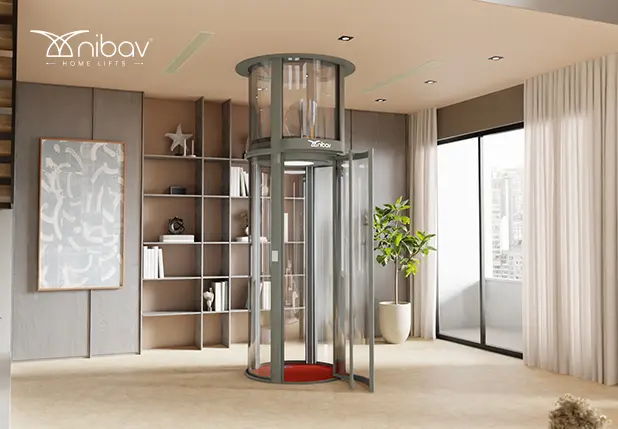
An air-driven lift — also called a vacuum elevator or pneumatic elevator — uses an air pressure differential to move the cabin. A turbine at the top of the self-contained shaft creates a pressure difference that lifts the cabin upward; controlled air release allows smooth descent. The entire drive mechanism is contained within the transparent cylindrical shaft.
No fluid to lift. No cables. No pit below the cabin. No machine room above or beside it. The lift is entirely self-supporting — it stands within its own footprint and requires no structural changes to the surrounding building to install.
Nibav’s entire product range — from the compact Series III Standard to the flagship Series V Max — is built on air-driven vacuum elevator technology.
Hydraulic Lift vs Air-Driven Lift: Side-by-Side Comparison
1. Civil Work and Installation
Hydraulic lift: Requires a pit (typically 150–400 mm excavation below the ground floor) for the piston cylinder. Also requires a dedicated machine room for the oil pump and control gear — either a room at the base or side of the shaft. In an existing Indian home, this means construction work before lift installation even begins. Total civil work costs can add ₹2–5 lakhs to the headline lift price.
Air-driven lift: No pit. No machine room. Self-supporting shaft. Installation requires only a clean circular floor opening at each level (for the shaft to pass through) and connection to standard single-phase power. Nibav installs in 24 to 48 working hours with no excavation and no structural changes.
2. Running Costs and Energy Efficiency
Hydraulic lift: Energy is consumed in both directions — the pump works to push the fluid and lift the cabin, and controlled release on descent still requires active system management. Hydraulic systems are generally less energy-efficient than air-driven alternatives for short-travel residential applications.
Air-driven lift: Power is consumed only during ascent. Descent is achieved through controlled air pressure release – requiring zero additional electricity. For a typical Indian household using the lift multiple times daily, this translates to meaningfully lower monthly electricity consumption.
3. Safety During Power Cuts
This is a particularly important comparison for Indian homes, where power interruptions are a fact of life in most cities.
Hydraulic lift: On power failure, the hydraulic pressure holding the cabin at height begins to slowly dissipate, causing the cabin to gradually lower — a process that may be uncontrolled without proper backup systems. Budget residential hydraulic installations often lack adequate emergency lowering mechanisms, requiring technician intervention.
Air-driven lift: Battery backup maintains cabin lighting, ventilation, and control systems. Automatic descent brings the cabin to the nearest floor safely and smoothly on a power cut. Nibav’s range includes this as standard; the Series V models add 30-minute auxiliary power for extended outages.
4. Maintenance in Indian Conditions
Hydraulic lift: Requires regular oil checks, hydraulic seal inspections, and periodic fluid changes. Seals and hoses are vulnerable to temperature-driven expansion and contraction — a significant factor in Indian climates with 35–42°C summer temperatures and high humidity in coastal cities like Chennai, Mumbai, and Kochi. Lubricant leaks, while rare, are messy and potentially damaging to surrounding floors and structures. Machine room components require periodic professional servicing.
Air-driven lift: No lubricant, no hydraulic seals, no cables to tension. The primary maintenance-relevant components are the turbine motor and the vacuum seal — both of which Nibav backs with a 25-year warranty on Series V models (CoreShield™). Fewer moving parts means fewer failure points and lower AMC (Annual Maintenance Contract) costs over time.
5. Noise Level
Hydraulic lift: The fluid pump creates a characteristic hum during operation. In residential settings — particularly in open-plan homes or homes with the machine room adjacent to living spaces — this mechanical noise can be noticeable.
Air-driven lift: Nibav’s Quiet 3.0 technology, combined with Suspension 2.0 damping and isolation pads around the motor, produces an operating noise of approximately 55 dB — quieter than a normal conversation. The ride is vibration-free and near-silent from inside the cabin.
6. Environmental Impact
Hydraulic lift: Hydraulic fluid is an environmental contaminant. Even in well-maintained systems, the risk of small leaks exists over a 20-year service life. Disposal of hydraulic fluid at servicing intervals requires proper handling.
Air-driven lift: No grease, no hydraulic fluid, no environmental contaminants. Powered by electricity alone, the zero-power descent characteristic means lifetime energy consumption is lower than equivalent hydraulic systems.
Where Hydraulic Lifts Have an Edge
In fairness, hydraulic lifts maintain advantages in specific contexts: very heavy load capacity requirements (beyond 400–500 kg), certain commercial applications, and situations where the ceiling height constraints make a top-mounted turbine impractical. For typical Indian residential applications — G+1 to G+3 homes, 210–240 kg capacity, 2–4 users — these advantages rarely apply.
Nibav Air-Driven Home Lifts: India Range and Pricing
| Series | Capacity | Starting Price (G+1) |
| Series III Standard | 210 kg | ₹11,99,000* |
| Series III Max | 240 kg | ₹14,99,000* |
| Series IV Standard | 210 kg | ₹16,69,000* |
| Series IV Max | 240 kg | ₹19,69,000* |
| Series V Standard | 210 kg | ₹19,49,000* |
| Series V Max | 240 kg | ₹22,49,000* |
All models are pitless, machine-room-free, TÜV NORD Certified, and installed in 24–48 working hours.
Prices are starting rates, exclude applicable taxes, and may vary based on customisation and installation.
Frequently Asked Questions
1. Which is better for an Indian home — a hydraulic or air-driven lift?
For Indian residential applications (G+1 to G+3), air-driven vacuum elevators are superior in nearly every dimension relevant to homeowners: no civil work required, lower running costs, better power-cut safety, lower maintenance, and no hydraulic fluid in the home. Hydraulic lifts may be appropriate for specific heavy-load commercial requirements.
2. Is an air-driven lift safe in India?
Yes. Nibav’s air-driven home lifts are TÜV NORD Certified to European safety standards. Every model includes emergency descent, battery backup, overload protection, door interlocks, and child safety controls.
3. What is the maintenance cost of an air-driven lift vs a hydraulic lift in India?
Air-driven systems have lower AMC costs because they have fewer moving parts and no fluid/grease to manage. Nibav’s Series V range includes a 25-year warranty on the motor and vacuum seal – the two most critical maintenance-relevant components.
4. Does an air-driven lift require a pit or machine room in India?
No. Nibav’s vacuum elevator range is entirely pitless and machine-room-free. This eliminates the ₹2–5 lakh civil work cost that hydraulic systems typically require.
5. How energy-efficient is an air-driven home lift compared to a hydraulic lift?
Air-driven lifts consume power only during ascent — descent requires zero electricity. Hydraulic systems consume energy in both directions. Over daily use in an Indian home, the cumulative electricity saving from an air-driven system is meaningful.
Conclusion:
The hydraulic vs air-driven lift decision has a clear answer for most Indian homeowners. Air-driven vacuum technology delivers better safety, lower running costs, simpler installation, and longer maintenance-free operation — specifically suited to the Indian residential context.
Nibav’s showrooms across India – Chennai, Bangalore, Mumbai, Hyderabad, Delhi, and more – let you experience the ride quality and finish standard firsthand.
Prices listed are starting rates, exclude applicable taxes, and may vary based on customisation and installation requirements.