
 By Sriram on April 28, 2026
|
By Sriram on April 28, 2026
|



Top Safety Features in ResidentialElevators: Complete Guide for Indian Homeowners (2026)
When you invite an elevator into your home, you are making a commitment to the safety of everyone who lives there, from your youngest child to your oldest parent. In 2026, the Indian home elevator market has grown rapidly, and not every product on offer meets the same safety benchmark.
Understanding what genuine residential lift safety systems look like, what certifications to demand, and which features to insist upon before signing any purchase agreement is not just informed buying. It is a responsibility to your family.
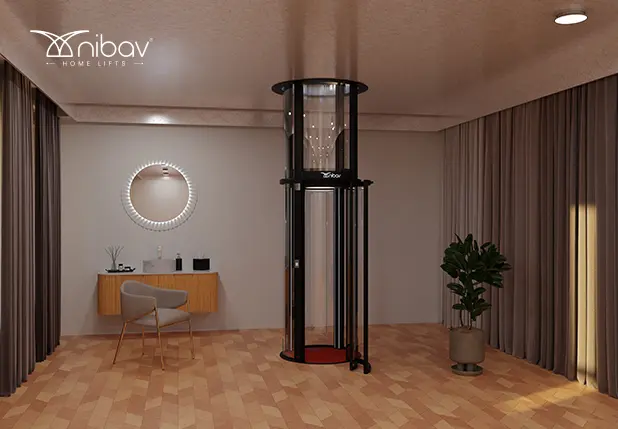
Nibav Home Lift India has built its global reputation on an engineering-first approach to safety. Every Nibav pneumatic vacuum elevator is designed with multiple independent safety systems that work in concert to protect passengers at every stage of operation.
From the moment you press the call button to the moment the door opens at your destination floor, a cascade of safety checks and balances is actively monitoring the lift’s performance. This guide explains every major safety feature you should expect from a modern vacuum elevator in India.
Table of Contents
▾- Safety Across Every Nibav Model
- What Makes Home Elevator Safety Features Unique Compared to Commercial Elevators?
- Core Safety Features to Demand in Every Home Elevator
- 5. Safety for Specific User Groups
- International Certifications: The Non-Negotiable Standard
- Nibav’s Safety Philosophy: Passive Safety First
- Frequently Asked Questions
- 1. What happens if there is a power cut while someone is inside the Nibav lift?
- 2. Are home elevators in India required to meet safety standards?
- 3. How does the door interlock work in a Nibav home elevator’s safety features?
- 4. Is a Nibav lift safe for an elderly person living alone?
- 5. How often should a home elevator be serviced?
Safety Across Every Nibav Model
Nibav’s home lifts safety-first engineering is consistent across its entire product range, whether you choose a compact model for a 2 BHK home or a larger cabin designed for family use.
Each model is built on the same pneumatic vacuum technology and follows identical safety principles, ensuring that safety is never dependent on the size or variant of the lift.
From the Series III Standard, designed for compact homes, to the more spacious Series III Max and Series IV Max, and up to the advanced Series V and Series V Max, every Nibav home elevator comes equipped with multiple layers of safety systems.
These include automatic emergency descent during power cuts, pressure-based lift operation (eliminating cables), mechanical locks, and real-time monitoring systems that ensure smooth and controlled movement at all times.
What changes between models is primarily space, capacity, and comfort—not safety. Whether it’s a 2-person lift or a 4-person family-friendly model, the same safety architecture is maintained across all variants, making Nibav one of the most reliable home elevator choices in India.
What Makes Home Elevator Safety Features Unique Compared to Commercial Elevators?
Home elevators operate in a fundamentally different environment than commercial building lifts. They are used by a more vulnerable user base, including elderly individuals with reduced mobility, young children who may not understand safety boundaries, and people with physical disabilities.
They operate in private spaces where professional supervision is absent. And they must function reliably through India’s specific challenges: frequent power cuts, high ambient temperatures, dust, humidity, and monsoon moisture.
This is why the residential lift safety systems must be evaluated against residential realities, not commercial benchmarks. A feature that is acceptable in a supervised commercial installation may be wholly inadequate in an unsupervised home environment.
Nibav’s engineers have designed the pneumatic elevator specifically for this context, incorporating automatic, passive safety systems that protect passengers without requiring any user action or technical knowledge.
Core Safety Features to Demand in Every Home Elevator
1. Automatic Emergency Descent with Battery Backup
Power failures are a daily reality across much of India. A home elevator without an independent power backup is an unacceptable risk. Nibav lifts include a built-in battery backup system that activates automatically the moment mains power is interrupted.
The lift does not stall between floors. Instead, it descends gently and automatically to the nearest floor, and the door opens smoothly, allowing passengers to exit without any manual assistance or technical intervention. This feature alone makes Nibav superior to lifts that rely on manual lowering in power-cut scenarios.
2. Multi-Layer Door Interlock System
One of the most common causes of elevator accidents is door failure, either a door that opens while the cabin is in motion or a lift that moves with an improperly latched door. Nibav’s multi-layer door interlock system prevents the lift from moving unless every landing door and the cabin door are fully closed and locked.
The system uses redundant sensors to verify door closure at each floor independently. If any sensor detects an improperly secured door, the lift remains stationary until the issue is resolved.
3. Pressure Relief and Overspeed Safety
Nibav’s pneumatic elevator incorporates pressure relief valves that prevent over-pressurisation of the air column above the cabin. In the unlikely event of a system anomaly, these valves release excess pressure automatically, preventing any uncontrolled movement.
Additionally, overspeed governors monitor the rate of cabin descent and engage braking mechanisms if descent velocity exceeds safe parameters, ensuring the cabin always stops within its designed deceleration range regardless of the underlying cause.
4. Emergency Stop and Manual Lowering
Every Nibav vacuum elevator includes an easily accessible emergency stop button inside the cabin that halts all movement immediately when pressed. For maintenance personnel and emergency responders, a manual lowering valve allows controlled descent of the cabin to a floor landing without electrical power.
These features ensure that in any conceivable emergency scenario, trained individuals can safely manage the lift and assist passengers without specialised equipment or prolonged response times.
| Safety Feature | Nibav Pneumatic Lift | Standard Traditional Lift |
| Battery backup emergency descent | Yes — automatic, no user action needed | Sometimes — often manual |
| Multi-layer door interlock | Yes — redundant sensors at each floor | Basic — single sensor typical |
| Overspeed governor | Yes — integrated pressure governor | Yes — mechanical brake |
| Manual emergency lowering | Yes — accessible valve | Yes — requires technician |
| ISO Certification | Yes | Varies by brand |
| TUV Certification | Yes | Varies by brand |
| Child safety lock | Yes | Varies by brand |
| Soft start and stop | Yes — pneumatic cushioning | Depends on control system |
5. Safety for Specific User Groups
Elderly Users
Nibav lifts are engineered with elderly users as a primary consideration. The cabin has no threshold lip that could cause a trip hazard. Doors are wide enough to enter comfortably without bending or twisting. Start and stop are pneumatically cushioned, eliminating sudden jolts that can destabilise elderly passengers.
Interior handrails provide a secure grip throughout the journey. Emergency stop buttons are positioned within easy reach at seated or standing height, making them accessible to all users regardless of physical ability.
Children
Child safety in the Nibav pneumatic elevator is primarily achieved through door interlock integrity and controlled access. Nibav’s door interlock system ensures that curious children cannot open a landing door and access an empty shaft because there is no open shaft in a pneumatic elevator.
The entire travel path is enclosed within the transparent cylinder, visible at all times. Access control options are available to restrict independent operation by young children, ensuring adult supervision is maintained when needed.
Wheelchair Users
Nibav offers configurations with wider cabin diameters specifically designed to accommodate standard wheelchairs. The flush floor threshold eliminates the step-up that creates a transfer hazard for wheelchair users. The cabin interior provides sufficient turning radius for comfortable entry and exit.
For homeowners with family members who use wheelchairs, a Nibav lift is a medically appropriate and dignified mobility solution that restores full access to all floors of the home.
International Certifications: The Non-Negotiable Standard
No discussion of home elevator safety is complete without addressing certifications. ISO and TUV certifications are the global benchmarks against which elevator safety is measured. ISO certification ensures that manufacturing processes meet international quality management standards.
TUV certification means the product has been independently tested and validated against rigorous engineering safety criteria by one of the world’s most respected third-party testing organisations. Nibav Home Lift India holds both, a combination that is not matched by every elevator brand operating in the Indian market.
When evaluating any home elevator for your Indian home, insist on seeing the original ISO and TUV certificates before making a purchase decision. A brand that cannot produce these certifications is a brand whose safety claims are unverified by independent bodies.
Nibav’s global presence across India, Southeast Asia, Australia, and Europe is sustained precisely because these certifications give homeowners, architects, and interior designers the confidence that they are specifying a product of validated, internationally benchmarked quality.
Install a Certified Safe Home Elevator — Book Your Free Nibav Safety Consultation Today.
Nibav’s Safety Philosophy: Passive Safety First
The core of Nibav’s home lifts safety design philosophy is passive safety, building systems that protect passengers automatically without requiring any user knowledge or action.
In a commercial building, trained operators manage elevator safety protocols. In your home, the safety system itself must be intelligent enough to handle every scenario without relying on passenger response.
This is why battery backup descent is automatic, why door interlocks are redundant, and why pressure relief is built into the pneumatic architecture rather than added as an afterthought.
This passive-first philosophy is what makes Nibav residential lift safety systems suitable for homes where elderly, very young, or differently-abled users will operate the elevator independently every day.
The lift is engineered to be safe by default, not safe by instruction. After 24 to 48 working hours of installation, your family has a fully certified, multi-redundant safety system protecting every vertical journey in your home for years to come.
Frequently Asked Questions
1. What happens if there is a power cut while someone is inside the Nibav lift?
The built-in battery backup system activates automatically. The cabin descends gently to the nearest floor, and the door opens safely without any action from the passenger. No one is ever stranded inside a Nibav lift during a power failure.
2. Are home elevators in India required to meet safety standards?
While national standards exist, the level of enforcement varies. This makes it even more important to choose a brand like Nibav that voluntarily adheres to international ISO and TUV standards rather than relying solely on local minimum compliance requirements.
3. How does the door interlock work in a Nibav home elevator’s safety features?
Nibav’s door interlock uses redundant sensors to verify that every landing door and the cabin door are fully closed and locked before allowing any movement. If any door is improperly closed, the lift remains stationary until the issue is corrected.
4. Is a Nibav lift safe for an elderly person living alone?
Yes. Nibav lifts are specifically designed for use by elderly individuals without supervision. Automatic emergency descent, smooth pneumatic operation, wide doors, interior handrails, and accessible emergency stop buttons make independent daily use safe and comfortable for elderly users.
5. How often should a home elevator be serviced?
Nibav recommends a professional service visit every six months. The pneumatic system has fewer moving parts than traditional elevators, which means lower maintenance frequency and lower service costs over the elevator’s lifetime.
Author
 Sriram
I'm Sriram, part of the Research & Development team. I specialize in home lift technology, working closely on innovations that make our elevators safer, more efficient, and better suited for modern homes. My role involves everything from testing new features to fine-tuning the performance of our latest lift models.

Rakesh Balakrishnan
The automatic emergency descent section was particularly useful. In India, where power interruptions can still happen, having the lift automatically move to the nearest floor instead of leaving passengers between floors is an important safety consideration.
Shreya Narayanan
I found the door interlock explanation easy to understand. Knowing that the lift should not move unless the landing and cabin doors are properly closed is something every homeowner should check before purchasing a residential elevator.
Aditya Balasubramanian
The article does a good job of explaining why safety features need to work automatically. Elderly people and children may not always know what to do during an emergency, so passive safety systems can be an important part of home elevator design.
Lakshmi Ramesh
The section on elderly and wheelchair users was helpful because accessibility is often overlooked when discussing elevator safety. Features such as flush thresholds, wider cabins, handrails, and accessible emergency controls can make everyday use more comfortable.