 By shanmugapriya on September 10, 2026
|
By shanmugapriya on September 10, 2026
|

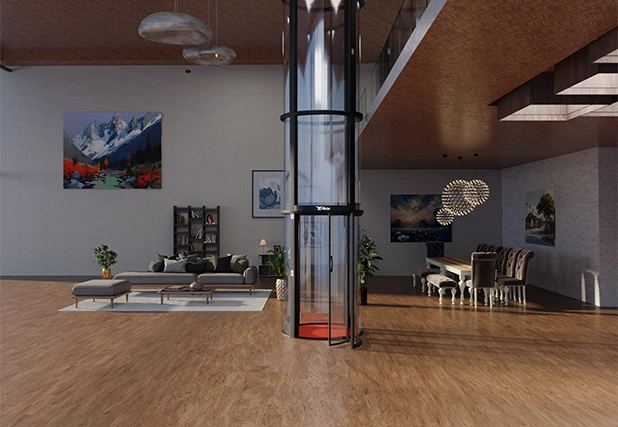
Home Elevator Safety Standards Every Mumbai Homeowner Should Know
The question is almost never asked outright, but it decides most purchases: what happens if it stops with my mother inside?
Everything else — finish, colour, price — is secondary to that. And it is a fair question, because most people’s mental model of a lift comes from commercial buildings: cables, counterweights, an emergency button that summons someone eventually, and stories about people waiting an hour. Transplanting that image into your own home, with an elderly parent using the lift alone several times a day while the family is out, is genuinely unsettling.
The reassurance worth having is specific rather than general. Home elevator safety rests on named mechanisms, verifiable certification and defined behaviour during failure — not on assurances that a product is “very safe.” This guide sets out the home lift safety standards a Mumbai homeowner should check, what each protective layer actually does, and precisely how a Nibav lift behaves when something goes wrong.
Table of Contents
▾- The Certification a Home Lift Should Carry
- What Happens During a Power Failure
- The Layers of Protection in a Nibav Home Lift
- Everyday Safety: Children, Elders and Daily Use
- Verifying Safety Before You Buy
- Frequently Asked Questions
- 1.What happens if a home elevator stops between floors?
- 2.Are home elevators safe during a power cut in Mumbai?
- 3.Are home lifts safe for elderly parents to use alone?
- 4.How do I stop children using the home lift unsupervised?
- 5.What safety certification should a home elevator have in India?
- 6.Is a vacuum home lift as safe as a conventional traction lift?
The Certification a Home Lift Should Carry
Start here, because certification is the one claim you can independently verify.
Ask which body certified the lift, against which standard, and for which specific variant — a certificate covering one model in a range does not automatically cover the one you are buying. Ask to see the document rather than a logo on a brochure.
Nibav home lifts are TÜV NORD certified and built to comply with European safety standards, including the Machinery Directive, which sets among the more demanding requirements for safety and structural integrity applied to this category. Manufacturing carries ISO 14001 (environmental management) and ISO 45001 (occupational health and safety) certification.
Separately, establish the regulatory position for your own installation. Home lift regulations Mumbai homeowners face come primarily from Maharashtra’s state lift legislation, under which permission from or registration with the Electrical Inspectorate may apply depending on the building and installation type, alongside your housing society’s own requirements. Confirm both in writing before ordering, and establish who is responsible for obtaining them.
What Happens During a Power Failure
This is the scenario people actually worry about, so it deserves a direct answer rather than a reassuring one.
In a Nibav air-driven lift, a power failure does not leave the cabin suspended. The system is designed so that the cabin descends automatically to ground level, where the doors can be opened and passengers step out unassisted. No technician is required, no wait is involved, and the descent is controlled rather than a drop — it works by releasing air in a governed way, which is the same mechanism used in normal operation.
That behaviour is worth understanding clearly, because it is unusual. The descent function does not depend on a battery or a temporary power supply to bring passengers down. Battery backup exists, and it keeps cabin lighting, ventilation and emergency communication running through an outage — so the cabin stays lit and comfortable — but the safe-exit mechanism itself is not contingent on it. On extended outages, auxiliary power keeps key systems active for around 30 minutes.
If the cabin stops between floors for any reason, an emergency landing switch inside the cabin — and a corresponding one outside it — brings the car down to the ground landing so the passenger can exit without assistance.
For a Mumbai household where an elderly parent uses the lift alone during the day, that sequence is the single most important thing to understand, and worth walking through with every family member after installation.
The Layers of Protection in a Nibav Home Lift
Safety in a residential lift is not one device. It is redundancy — several independent systems, each covering a different failure mode.
| Safety layer | What it does |
| Automatic descent on power failure | Cabin travels to ground level; doors open for unassisted exit |
| Emergency landing switch | Inside and outside the cabin; brings the car safely down if stopped between floors |
| Sure Stop system | Locks the cabin within two inches if pressure is lost or speed exceeds safe limits |
| Brakes 3.0 with precision landing | Instant, accurate stopping and level landings at each floor |
| Cabin door detection and interlocks | Lift will not move unless every landing and cabin door is fully closed and locked |
| EEM Ride Check | Triple-layer door safety sensing |
| Smart Overload Alert | Prevents operation beyond the rated weight limit |
| Child switch and parental scheduling | Restricts unauthorised or unsupervised use by children |
| Rapid Rescue Latch (RRL) | Allows quick, safe cabin access for rescue or technicians |
| Conventional manual door unlock | Doors can be opened from outside in rare emergencies |
| Layman Rescue System | Designed to be operated safely by a non-technical person |
| Battery 2.0 and 30-minute auxiliary power | Keeps lighting, ventilation and controls active during outages |
| Stationary GSM | Two-way emergency communication that works even when the lift is idle or coverage is weak |
| SmartConnect™ (Series V / V Max) | Emergency communication integrated into the touchscreen; functions during power outages |
| Polycarbonate cabin walls | High-strength material, rated far stronger than conventional glass |
Two entries there deserve emphasis for Mumbai households specifically. Stationary GSM matters because it works when the lift is idle — a person who enters, presses nothing, and then needs help is still connected. And the Layman Rescue System matters because in the moment that assistance is needed, the person present is a family member or domestic staff, not an engineer.
Everyday Safety: Children, Elders and Daily Use
Certification covers the equipment. Day-to-day safety also depends on how a household uses it.
For elderly users, the risks that matter are trips at the threshold and unsteady entry. Precision landing addresses the first by ensuring the cabin stops level with the floor rather than leaving a lip. A folding cabin seat and leather-wrapped handrails help with the second. Wide door openings — widest in class on the GlideWide™ models — make entry with a walking aid straightforward, and the Max variants accommodate a wheelchair with an attendant.
For children, the child switch and parental scheduling restrict use when adults are not present. It is worth setting this up on day one rather than after an incident, and worth teaching children that the lift is not a toy — though the panoramic cabin, which many families report children love, makes that conversation easier than with an enclosed box.
For everyone, three habits: respect the rated capacity (210 kg on standard models, 240 kg on Max variants); keep landing door tracks clear; and report unusual noises early rather than after months. A sound reported in week one is usually an adjustment.
Verifying Safety Before You Buy
Five checks, all reasonable to ask of any supplier.
- Ask for the certificate, for your specific model and variant, from the named certifying body.
- Ask what happens during a power failure — and listen for whether the answer describes a mechanism or offers reassurance.
- Ride the lift before ordering. Nibav operates 40+ experience centres across India within a 55+ global network, which lets you test entry, exit and landing accuracy in person rather than from a brochure.
- Ask for a demonstration of the safety features individually at commissioning, and insist on a written commissioning certificate confirming the lift was tested at every landing.
- Ask about service reachability — Nibav runs a dedicated service line on +91 89259 32118 and servicecare@nibavlifts.com, separate from sales, backed by 500+ technicians worldwide.
Safety in a home lift is ultimately a combination of certified engineering, redundant mechanisms and a service organisation that responds. All three are verifiable before you sign.
To arrange a demonstration or a site feasibility visit in Mumbai, call +91 78248 12121 or visit your nearest Nibav experience centre.
Frequently Asked Questions
1.What happens if a home elevator stops between floors?
In a Nibav lift, the emergency landing switch — located inside the cabin and also outside it — brings the car down to the ground landing so passengers can step out without assistance. No technician visit is needed to exit. Battery backup keeps lighting, ventilation and emergency communication active throughout.
2.Are home elevators safe during a power cut in Mumbai?
Yes, and the behaviour is specific: the cabin descends automatically to ground level and the doors open for unassisted exit. The descent mechanism does not depend on battery power, though battery backup keeps cabin lighting, ventilation and emergency communication running, with roughly 30 minutes of auxiliary power for extended outages.
3.Are home lifts safe for elderly parents to use alone?
They are designed for exactly that. Precision landing eliminates the threshold lip that causes trips, wide door openings ease entry with a walking aid, automatic descent covers power failure, and in-cabin GSM communication works even when the lift is idle. Walk every family member through the emergency landing switch after installation.
4.How do I stop children using the home lift unsupervised?
Nibav lifts include a child switch and parental scheduling, which restrict operation to permitted times or authorised use. Set both up at handover rather than later.
5.What safety certification should a home elevator have in India?
Ask which body certified the lift, against which standard, and for which variant. Nibav home lifts are TÜV NORD certified and built to comply with European safety standards including the Machinery Directive, with ISO 14001 and ISO 45001 behind the manufacturing. Ask to see the certificates for your specific model.
6.Is a vacuum home lift as safe as a conventional traction lift?
It relies on different mechanisms rather than fewer. With no cables, counterweights or pulleys, an entire category of failure modes is absent, while the Sure Stop system, door interlocks, dual braking, overload sensing and automatic descent cover the remaining ones. What matters more than the technology is certification, redundancy and service response — verify all three.
Author
No comments yet.