 By shanmugapriya on May 13, 2026
|
By shanmugapriya on May 13, 2026
|



Stairlift vs Home Elevator in India: Cost, Comfort & Which Is Right for You?
When a family member starts struggling with the stairs, the first instinct is usually to find the fastest and cheapest fix. And for many Indian families, a stairlift seems to tick both boxes – it mounts onto the existing staircase, doesn’t require major construction, and is priced lower than a home elevator. It sounds like a practical choice.
But here’s what most families discover after the stairlift is installed: the quick, cheap fix often creates new problems. The staircase is now partially obstructed. A wheelchair user still can’t get between floors. Guests and other family members find the mounted rail awkward to navigate around. And the person who was supposed to benefit from it is using it less and less because the mounting, dismounting, and transfer process feels precarious every time.
The stairlift vs home elevator in India comparison deserves a careful, honest look — not just at upfront cost but at what actually serves your family well over the years ahead.
Table of Contents
▾- What Is a Stairlift and How Does It Work?
- What Is a Home Elevator and How Is It Different?
- Stairlift vs Home Elevator: Honest Comparison for Indian Homes
- Frequently Asked Questions
- 1. Is a stairlift or home elevator better for elderly parents in India?
- 2. What is the cost of a stairlift vs a home elevator in India?
- 3. Can a stairlift accommodate a wheelchair user?
- 4. Does a home elevator require major construction in an Indian home?
- 5. Does installing a home elevator add value to an Indian property?
- Conclusion
What Is a Stairlift and How Does It Work?
A stairlift consists of a motorised chair or platform that travels along a rail fixed to the wall or staircase in your home. The user sits in the chair (or stands on the platform), presses a button, and is carried up or down the staircase while remaining in contact with the steps or the rail structure.
Stairlifts are used widely in accessibility applications, particularly in older European homes where staircase dimensions and listed building restrictions make elevator installation impractical. In the Indian market, they are available from several suppliers and are priced in the ₹3–7 lakh range for a straight staircase installation.
For short-term or single-user accessibility needs, they can be a reasonable interim solution. But they come with structural and practical limitations that become increasingly significant over time, such as the need for regular maintenance, potential space constraints, and limitations in weight capacity.
What Is a Home Elevator and How Is It Different?
A home elevator is a fully enclosed cabin system that transports passengers vertically between floors inside a sealed shaft. The cabin can hold one or more people, and the system works independently of the stairs.
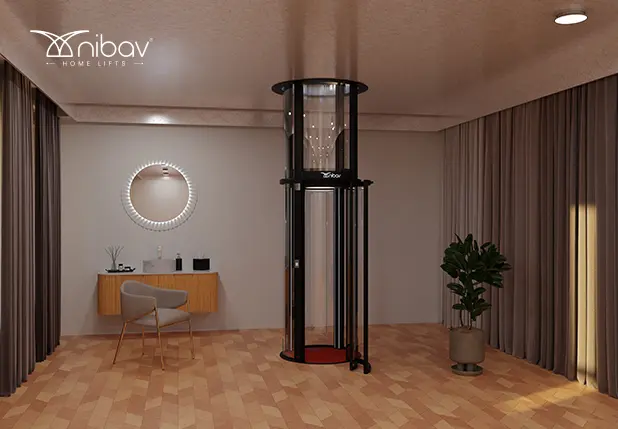
Modern home elevators for Indian residences — like Nibav’s vacuum elevator range — are designed specifically for villa and duplex applications. They require no pit, no machine room, and no structural changes to the building. They install in 24–48 working hours and integrate into the home as a permanent, finished feature.
Stairlift vs Home Elevator: Honest Comparison for Indian Homes
1. Effect on the Staircase
Stairlift: A rail is permanently mounted onto the wall or stair treads of your staircase. The chair mechanism occupies a portion of the stair width. For narrow Indian staircases, which are common in older villas and compact homes— this rail and chair can significantly reduce the usable width for other family members. Carrying things up and down becomes more awkward, and the staircase that was already manageable becomes less so for everyone else in the house.
Home elevator: Installed in a separate location — a corner, beneath an open staircase, in the car port, or any suitable space. Other family members can fully use the staircase without any hindrance.
2. Wheelchair Accessibility
Stairlift: Standard seated stairlifts cannot accommodate wheelchairs. The user must transfer from wheelchair to stairlift chair at the bottom, ride up, transfer to another wheelchair at the top, and reverse the process on return. For elderly users with balance issues, transfer strength limitations, or progressive mobility conditions, this transfer sequence is both difficult and potentially dangerous.
A perch-style or platform stairlift can handle wheelchairs, but these are significantly more complex, more expensive, and require wider staircases than most Indian homes have.
Home elevator: Nibav’s Max series models (Series III Max, IV Max, and V Max) with 1160–1240 mm cabin diameters accommodate standard wheelchairs with an attendant. No transfer required — the wheelchair enters the cabin directly, the doors close, and the user arrives at the next floor still in their chair.
3. Safety During Power Cuts
Stairlift: Most stairlifts have battery backup that allows the chair to complete a journey in progress during a power cut. However, if the battery is depleted or the cut occurs at an inopportune moment on a steep staircase, the situation can be risky — particularly for an elderly user alone in the house.
Home elevator: Nibav’s full range includes automatic emergency descent to the nearest floor in the event of power failure, with battery backup keeping lights and ventilation active. The passenger is inside a sealed, safe cabin throughout. This level of protection is meaningfully superior to an open stairlift chair on a steep staircase during a power interruption.
4. Cost Comparison
Stairlifts in India: Straight staircase models typically range from ₹3 to 7 lakhs installed. Curved staircase models (required for most Indian L-shaped or spiral staircases) can reach ₹10–14 lakhs due to the custom rail fabrication required. Platform stairlifts for wheelchairs are at the higher end of this range.
Home elevator in India (Nibav):
- Series III Standard (G+1): from ₹11,99,000*
- Series III Max (G+1, wheelchair-accessible): from ₹14,99,000*
Initially, the stairlift seems more affordable. But consider this: for a curved staircase (which describes most Indian villa staircases), the stairlift cost approaches or overlaps with the home elevator price range — while delivering a significantly inferior solution. And the home elevator adds property value; the stairlift typically does not.
Prices are starting rates, exclude applicable taxes, and may vary.
5. Aesthetics and Home Value
Stairlift: The rail and chair mechanism is visually prominent on the staircase — a purely functional addition that most homeowners would not describe as a design feature. It signals an accessibility need rather than a lifestyle upgrade. It does not enhance property resale value and may actually complicate sales to buyers who don’t need it.
Home elevator: A well-designed vacuum glass elevator is a positive design element in a premium Indian home. Nibav’s panoramic polycarbonate cabin, premium finish options, and customisable interiors allow homeowners to specify the lift to complement their home’s existing aesthetic. It consistently adds to property resale value — particularly in the Chennai, Bangalore, and Hyderabad luxury villa markets.
6. Future-Proofing
Stairlift: Serves the current user’s current condition. If their mobility needs change—or if they transition to full-time wheelchair usage— a seated stairlift may no longer be usable. Multiple users with different needs cannot typically share a single stairlift configuration.
Home elevator: Serves all household members across all conditions. A home that installs a Nibav elevator today is equally accessible to a toddler, a teenager, a 45-year-old adult, and an 80-year-old wheelchair user. The lift adapts to the family’s changing needs, not the other way around, ensuring that it remains a practical solution for mobility as family members age or experience changes in their physical abilities.
Frequently Asked Questions
1. Is a stairlift or home elevator better for elderly parents in India?
For most Indian families with elderly parents in multi-story homes, a home elevator is the better long-term solution. It provides a fully enclosed, safe environment, accommodates wheelchairs (in Max models), doesn’t require a physically difficult transfer process, and doesn’t obstruct the staircase for other family members.
2. What is the cost of a stairlift vs a home elevator in India?
Stairlifts for straight staircases start around ₹3–4 lakhs; curved staircase models can reach ₹10–14 lakhs. Nibav’s home elevators start at ₹11,99,000 for a G+1 installation. For curved staircase applications and wheelchair-accessible requirements, the cost difference narrows significantly while the home elevator delivers substantially better outcomes.
3. Can a stairlift accommodate a wheelchair user?
Standard seated stairlifts cannot; the user must transfer from wheelchair to chair and back, which is difficult and risky for many elderly users. Nibav’s Max series home elevators (Series III Max, IV Max, and V Max) are specifically designed for wheelchair access with a companion.
4. Does a home elevator require major construction in an Indian home?
Not with Nibav’s vacuum elevator technology. The range is pitless and machine-room-free, installed in 24–48 working hours, and requires no structural changes to the building — making it as straightforward to retrofit as a stairlift, with a permanently superior outcome.
5. Does installing a home elevator add value to an Indian property?
Yes. A well-installed home elevator — particularly in the villa and luxury home segment — enhances both lifestyle value and property resale appeal. A stairlift does not typically add resale value and may need to be removed before sale.
Conclusion
The stairlift might look like the easy answer. But for most Indian families in multi-storey homes, the home elevator is the right answer – safer, more accessible, more aesthetically appropriate, and genuinely better value over a 15–20 year horizon.
Author
No comments yet.