 By shanmugapriya on May 13, 2026
|
By shanmugapriya on May 13, 2026
|



Glass Lift vs Metal Lift: Design, Safety & Price Comparison for Residential Homes
Home elevators in India have moved well beyond utility. For the growing number of homeowners who treat their villa or duplex as a considered design project — not just a structure to live in — the elevator is increasingly a focal point: a statement piece that either elevates the interior or undermines it. And at the centre of most design conversations about home lifts is one fundamental question: glass or metal?
It seems like a simple aesthetic choice. It isn’t. The difference between a glass lift and a metal lift touches on more than appearance — it affects how the space around the lift feels, how the lift integrates with different architectural styles, what the maintenance and durability picture looks like over time, and in some cases, how safe and comfortable the ride feels for the people using it every day.
This guide gives you an honest, detailed comparison of glass lifts vs metal lifts — for design, safety, pricing, and practical suitability for modern Indian homes.
Table of Contents
▾What Is a Glass Lift?
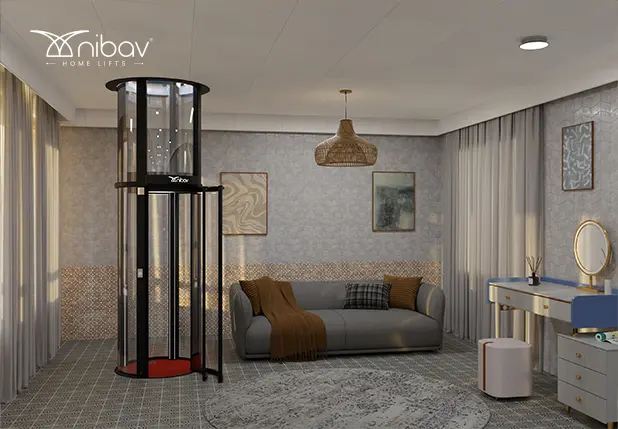
A glass lift uses transparent material — typically high-strength polycarbonate or tempered glass — for the cabin walls and/or the external shaft. The defining characteristic is visual openness: passengers can see into and out of the lift cabin during travel, the surrounding space remains visually connected through the lift, and the shaft itself becomes a transparent architectural element rather than an opaque structural intrusion.
In the Indian residential market, the dominant glass lift technology is the vacuum (air-driven) elevator — like Nibav’s full product range — which uses a panoramic polycarbonate cylinder shaft and transparent cabin panels. The transparency is structural: the polycarbonate used is 250 times stronger than standard glass, making it a genuine safety material, not just an aesthetic one.
What Is a Metal Lift?
A metal lift uses opaque metal panels — typically steel, aluminium, or stainless steel — for the cabin walls and structural elements. Traditional elevator cabins in commercial buildings, older apartment blocks, and many budget residential applications are metal-panelled: functional, durable, and visually enclosed.
Metal home lifts can range from basic functional cabins to premium stainless steel-finished interiors. Some modern metal home lifts incorporate partial glass panels, brushed metal accents, or mixed-material designs that blend both categories.
Glass Lift vs Metal Lift: Detailed Comparison
1. Visual Impact and Interior Integration
Glass lift: Transparency is the defining advantage. A glass lift cabin and shaft do not visually divide a space — they allow light to pass through, sightlines to remain open, and the home interior to flow continuously around and through the lift structure. In open-plan villas, double-height living rooms, and modern minimal interiors, a glass lift is a positive architectural element. The lift becomes part of the design, not an imposition on it.
Metal lift: An opaque metal cabin and shaft create a visual mass in whatever space they occupy. In a well-designed interior, a metal lift shaft reads as a structural interruption. Premium metal finishes (brushed stainless and powder-coated panels) improve the situation but cannot replicate the visual lightness of a transparent design.
2. Claustrophobia and Passenger Comfort
Glass lift: The transparent cabin eliminates the enclosed feeling that troubles many lift users. Passengers can see the surrounding space throughout the journey — floors, walls, people, light. For elderly users, children, and anyone who experiences mild anxiety in enclosed spaces, a glass cabin is meaningfully more comfortable.
Metal lift: The enclosed, opaque cabin creates a tighter psychological environment — particularly in compact cabin sizes where the walls are close. For users prone to claustrophobia or anxiety, this can make regular lift use uncomfortable.
3. Light and Spatial Effect
Glass lift: Because light passes through the transparent shaft, the area around the lift remains naturally illuminated. The lift doesn’t create a shadow or a dark corner in the surrounding space. In stairwell installations — where the lift is placed beside or within the staircase void — a glass shaft maintains the visual openness of the space.
Metal lift: An opaque shaft blocks light and creates visual density in its immediate surroundings. In compact Chennai or Bangalore homes where natural light is carefully managed, a solid metal shaft can meaningfully darken an adjacent area.
4. Durability and Weather Resistance
Glass lift (polycarbonate): High-strength polycarbonate – the material used in Nibav’s shaft cylinders – is 250 times stronger than standard glass, impact-resistant, UV-stabilised for Indian sun exposure, and resistant to temperature variation. It does not corrode, rust, or require painting. Surface scratches can develop over very long-term use but are addressable with polishing compounds.
Metal lift: Steel and aluminium panels are structurally durable but require surface protection (powder coating, anodising, or stainless steel grades) to resist humidity and corrosion — particularly relevant in Chennai, Mumbai, Kochi, and other coastal cities where salt-laden humid air accelerates metal deterioration. Painted metal panels can chip or fade over time and may require periodic refinishing.
5. Design Customisation
Glass lift (Nibav range): Available in 24+ colour and finish combinations — standard, textured, metallic, hydro-matt, and hydro-glossy editions. The transparent cabin can be combined with premium leather interiors, ambient mood lighting, illuminated ceiling features (SkyMark™), and laser-engraved personalisation (HeartLine™). The result is a product that can be styled to complement any interior direction.
Metal lift: Premium metal lift cabins offer brushed or mirrored finishes, custom panel configurations, and varied material combinations. However, the fundamental opacity of the design limits the aesthetic vocabulary — a metal lift will always read as an enclosed unit regardless of surface finish quality.
6. Safety
Both glass and metal lifts can be engineered to high safety standards — the material of the cabin is not the primary determinant of safety. What matters is the engineering behind the lift system.
Nibav’s glass vacuum elevators carry TÜV NORD Certification to European safety standards — independent verification of safety and performance. Key safety features across the range include emergency descent, battery backup, overload protection, door interlocks, child safety controls, and brake systems. These are standard across every model, regardless of finish or cabin size.
The polycarbonate material itself adds a safety dimension: it is shatter-resistant in a way that standard glass is not, meaning it will deform under extreme impact rather than fracturing.
7. Price
Glass lift (Nibav range):
- Series III Standard: from ₹11,99,000*
- Series IV Standard: from ₹16,69,000*
- Series V Standard (with full premium glass features): from ₹19,49,000*
Premium glass lifts incorporate the transparent shaft as part of their standard design — it is not an upgrade to pay for separately.
Metal lift: Budget metal home lifts can be priced below Nibav’s entry point but typically involve hydraulic or traction systems that add civil work costs (pit, machine room) not included in the headline price. Premium metal cabin finishes add cost at the upper end.
For an all-in comparison – including civil work – Nibav’s glass vacuum elevators are often more competitively priced than metal alternatives once total installation cost is calculated.
Prices are starting rates, exclude applicable taxes, and may vary.
Frequently Asked Questions
1. Is a glass lift safer than a metal lift for Indian homes?
Safety is determined by engineering and certification, not the material alone. Nibav’s glass vacuum elevators are TÜV NORD Certified to European safety standards — a credible independent assurance. The polycarbonate used is 250 times stronger than standard glass and shatter-resistant. Verify certification for any lift you consider, regardless of material.
2. Which is better for a Indian villa — a glass or metal lift?
For Indian villa interiors, glass lifts are typically the superior design choice. The transparent shaft preserves visual openness, allows light to pass through, and integrates with contemporary interiors as a design element. Metal lifts create visual mass and work better in industrial or traditional architectural contexts.
3. Are glass lifts more expensive than metal lifts in India?
Not necessarily when total installation cost is considered. Nibav’s glass vacuum elevators are pitless and machine-room-free — no civil work additions. Metal lifts using hydraulic or traction systems often require pit excavation and machine room construction that add ₹2–5 lakhs to the headline price. The all-in comparison frequently favours the glass vacuum elevator.
4. Do glass lifts require more maintenance than metal lifts?
No. Nibav’s polycarbonate glass vacuum elevators require less maintenance than hydraulic metal lift systems — no fluid changes, no cable tensioning, no hydraulic seal inspections. The vacuum seal and motor are backed by a 25-year warranty on Series V models.
5. Can glass home lifts be customised for Indian home interiors?
Yes. Nibav’s range offers 24+ colour and finish combinations, premium leather cabin interiors, ambient lighting, illuminated ceiling features, and laser-engraved personalisation. The transparent shaft can be combined with any finish direction to complement your home’s aesthetic.
Conclusion:
The glass lift vs metal lift comparison is one that really benefits from being experienced firsthand — photographs and brochures don’t fully convey what a panoramic glass vacuum elevator does to the feeling of a space. Nibav’s showrooms across India let you step inside an actual cabin and see the visual effect for yourself.
Prices listed are starting rates, exclude applicable taxes, and may vary based on customisation and installation requirements.
Author
No comments yet.