
 By shanmugapriya on July 30, 2026
|
By shanmugapriya on July 30, 2026
|

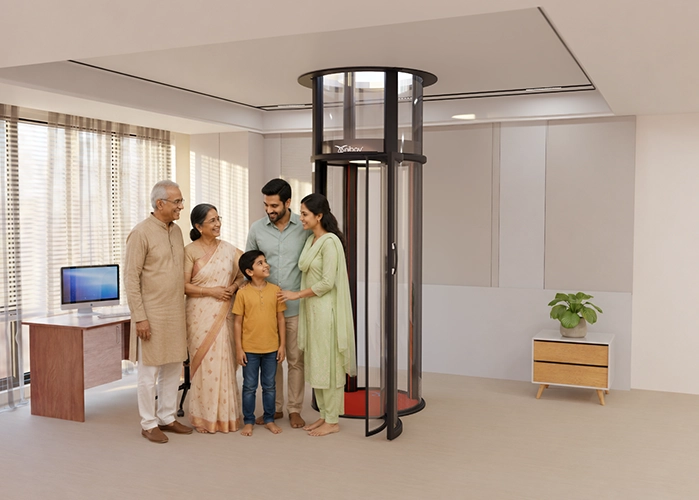
Residential Elevators in India: Trends, Technology, and Future Innovations (2026)
Ten years ago, a residential elevator in an Indian private home was a conversation point. Five years ago, it was a premium aspiration. Today, it is a mainstream consideration for any multi-floor villa owner who takes their home’s long-term functionality seriously. The shift has happened faster than most industry observers predicted — and the technology driving it has changed just as dramatically as the market sentiment.
Residential elevators in India in 2026 are not adapted commercial systems with residential price tags. They are purpose-built products engineered specifically for Indian home layouts, Indian installation constraints, Indian climate conditions, and the specific mobility needs of multi-generational Indian households. Understanding the trends shaping this category — and the technology innovations arriving in it — helps homeowners make decisions that will serve them for the next two decades.
Table of Contents
▾- The Technology Shift: From Hydraulic to Air-Driven
- Smart Residential Lifts: The Technology Entering the Market in 2026
- Residential Home Elevators: Design Trends Shaping India’s Premium Market
- The Future of Residential Elevators in India: What’s Coming
- Why Nibav Home Lifts Is at the Forefront of Residential Elevator Innovation in India
- Why People Choose and Love Nibav Home Lifts Above All Others
- Frequently Asked Questions: Residential Elevators in India
- 1. What is the most popular type of residential elevator in India in 2026?
- 2. How much do smart residential elevators cost in India?
- 3. What safety certifications should Indian residential elevators carry?
- 4. Are residential elevators becoming more common in Indian middle-class homes?
- 5. What is the future of home elevator technology in India?
The Technology Shift: From Hydraulic to Air-Driven
The single most significant technology shift in India’s residential elevator market over the last five years is the rapid adoption of vacuum (pneumatic) elevator technology over hydraulic alternatives.
Why hydraulic dominated: Traditional hydraulic systems were the established residential elevator technology for decades. They offered smooth, reliable rides at reasonable speeds. The civil work they required — pit excavation, machine room construction, shaft walls — was accepted as a standard installation cost.
Why vacuum is winning: In the Indian residential context, the civil work requirements of hydraulic systems proved to be the decisive disadvantage. For the majority of Indian homeowners who live in existing homes — not new construction — the weeks of excavation and construction that hydraulic installation demands are a practical barrier that vacuum technology eliminates entirely.
Modern vacuum elevators require no pit, no machine room, and no structural shaft walls. They install in 24–48 working hours in occupied Indian homes, with the quoted price being the all-in price. For a market where most elevator buyers are retrofitting existing properties, this difference is decisive.
Smart Residential Lifts: The Technology Entering the Market in 2026
The most visible innovation in India’s residential elevator market in 2026 is the integration of smart features that were previously available only in commercial elevator products — now appearing as standard or accessible options in residential models.
- Touchscreen interfaces with customisable themes: Replacing the dated push-button panels of previous generations, responsive touchscreens with adjustable interfaces are becoming the residential standard in mid-range and premium models.
- Integrated emergency communication: Rather than a separate GSM handset in the cabin, advanced models now integrate two-way emergency communication directly into the touchscreen interface — active independently of mains power, with no separate device to maintain.
- Automatic sensor-based doors: The world’s first automatic landing doors on a vacuum residential elevator — opening as the cabin arrives, without physical contact — have arrived in the Indian market. For elderly residents who use the elevator daily, this removes the most significant daily physical interaction from the ride experience.
- Smart home integration: Voice control compatibility and integration with home automation platforms are entering the residential elevator category. The ability to call the elevator from a phone app or voice command is transitioning from novelty to practical expectation.
- Parental scheduling: Digital scheduling of elevator operation hours — particularly relevant for households with young children — is now available on advanced models, allowing parents to set specific hours when the elevator is active.
Residential Home Elevators: Design Trends Shaping India’s Premium Market
- Transparency as a design statement: The transparent panoramic polycarbonate cabin has become the aesthetic standard in India’s premium home elevator market. The enclosed opaque cabin is increasingly seen as dated in premium villa contexts where the elevator is in a visible interior location.
- Personalised cabin interiors: Laser-engraved personalisation — family names, dedications, custom designs applied permanently to the cabin wall during manufacturing — is arriving as a distinguishing premium feature. Leather cabin panels, New Zealand wool flooring, and ambient mood lighting are moving from luxury features to expected mid-range specifications.
- Screwless exterior design: The concealment of all visible fasteners behind sculpted exterior panels — producing a continuous, uninterrupted shaft surface — is becoming the design standard for premium residential models. The visual difference from hardware-visible earlier models is significant.
- Metallic and textured exterior finishes: Moving beyond standard polycarbonate and powder-coated exteriors, 2026’s premium models offer textured, metallic, hydro-gloss, and hydro-matt shaft finishes in 20+ colour combinations.
The Future of Residential Elevators in India: What’s Coming
- Greater energy efficiency: The zero-power descent characteristic of vacuum elevators — already a major advantage — is likely to improve further as turbine motor efficiency advances. Monthly operating costs will continue to decline as the technology matures.
- Longer warranty coverage: The 25-year warranty on motor and vacuum seal, currently available on flagship models, is likely to become the benchmark expectation across the premium tier as manufacturing confidence in component longevity increases.
- Broader accessibility integration: As India’s elderly population grows — 340 million people are projected to be over 60 by 2050 — residential elevator design will increasingly incorporate accessibility features as standard rather than optional. Wider cabins, automatic doors, and flush cabin entry will move from Max/premium tier to standard.
- Increased standardisation of safety certification: TÜV NORD Certification is increasingly the minimum expected standard for premium residential elevators in India. Market pressure will likely push this toward broader adoption across price tiers as buyer awareness grows.
Why Nibav Home Lifts Is at the Forefront of Residential Elevator Innovation in India
Among all residential elevator brands operating in India, Nibav is the one whose product range most completely reflects the technology and design trends shaping the market’s future.
Nibav introduced the world’s first automatic sensor-based doors on a vacuum residential elevator — AutoGlide™ — making India one of the first markets globally to see this feature in production. The Series V range, which launched with this feature, also introduced HeartLine™ laser-engraved cabin personalisation, SmartConnect™ integrated emergency communication, ZeroTrace™ screwless exterior design, and CoreShield™ — a 25-year warranty on the motor and vacuum seal — each of which represents a category-first in the Indian residential elevator market.
Nibav’s platform is also the one on which every future innovation will likely be built: a pitless, machine-room-free, TÜV NORD Certified foundation that installs in 24–48 working hours. The smart features sit on top of this practical foundation — which is what makes them deployable in India’s residential market rather than interesting in concept but impractical in execution.
Why People Choose and Love Nibav Home Lifts Above All Others
The reasons Nibav consistently earns loyalty from Indian homeowners across markets go beyond product specification. Three things come up repeatedly in customer feedback and industry observation:
- Transparent, all-in pricing: In a market where hidden civil work costs are endemic, Nibav’s all-in pricing — the quoted price is the installed price — is both unusual and deeply valued. Families who have been burned by post-contract cost additions elsewhere find Nibav’s pricing approach one of the most distinctive things about the brand.
- Local service that actually shows up: Nibav’s Chennai headquarters and network of 40+ experience centres across the world means service teams are genuinely local. AMC callouts happen when scheduled. Issues are resolved by people who know the product and know the local installation context. This matters enormously for a product that is used daily and whose reliability directly affects family members’ independence.
- A product that earns trust over time: The most consistent testimonial from Nibav owners is not that the product impressed them at purchase — it’s that it continued to perform exactly as expected across years of daily use. For an investment that lives in a home for 20 years, this long-term reliability is the most important thing a residential elevator brand can deliver.
Frequently Asked Questions: Residential Elevators in India
1. What is the most popular type of residential elevator in India in 2026?
Vacuum (air-driven) elevators, led by brands like Nibav Home Lifts, have become the most popular residential elevator type in India, thanks to no-civil-work installation and easy retrofitting into existing homes.
2. How much do smart residential elevators cost in India?
Smart residential elevators with touchscreen controls, integrated emergency communication, and automatic doors start from approximately ₹19,49,000* for G+1 installations. Mid-range models with touchscreen controls start from ₹16,69,000*.
3. What safety certifications should Indian residential elevators carry?
TÜV NORD Certification — independently issued by a European technical inspection authority — is the most credible safety standard for residential elevators in India. ISO quality certification is also relevant to manufacturing quality assurance.
4. Are residential elevators becoming more common in Indian middle-class homes?
Yes — rapidly. The shift from luxury to mainstream has been driven by pitless vacuum technology reducing total installed costs to ₹12–16 lakh range for certified models, and by growing awareness of ageing-in-place planning among Indian homeowners in their 40s and 50s.
5. What is the future of home elevator technology in India?
Greater smart integration, longer warranty coverage on core components, wider accessibility features as standard, and continued shift toward vacuum technology over hydraulic — driven by India’s growing retrofitting market and rising elderly population.
Recommended Reading
- Top Safety Features in Residential Home Elevators: Complete Guide for Indian Homeowners (2026)
- Top Residential Lifts in Karnataka: Models and Prices for Every Home
- What is the Smallest Residential Elevator – Compact Home Lifts Guide

Arun Mehta
Really enjoyed reading this. I had always assumed residential elevators were mainly for new homes, so the explanation about vacuum technology and easier installation in existing houses was useful. The smart features mentioned for 2026 are also interesting. It’s good to see residential elevators in India becoming more practical instead of being seen only as a luxury.
Priya Iyer
This was a helpful article, especially for families who are planning their homes with older parents in mind. I liked the point about accessibility becoming a bigger part of residential elevator design. Automatic doors and easier controls may seem like small improvements, but they can make a real difference when the lift is being used every day.
Rohan Kapoor
Quite an interesting look at where residential elevators are heading. The move from traditional systems toward vacuum elevators makes sense when you consider the amount of construction involved in retrofitting a home. I also liked the discussion about smart home integration. Residential elevators in India seem to be becoming much more technology-driven than they were a few years ago.
Sneha Iyer
I found this article useful because it covers more than just the basic benefits of having a lift at home. The installation side was particularly helpful. Not needing a pit or separate machine room could make residential elevators a much more realistic option for homeowners who are upgrading an existing property rather than building from scratch.
Vikram Joshi
There are some good points here about how the purpose of a home elevator is changing. It’s not simply about making a house look more premium anymore. For families thinking about long-term comfort, mobility, and ageing at home, residential elevators can be a practical addition. The section on future accessibility improvements was especially worth reading.
Kavya Menon
A very relevant read for anyone researching residential elevators in India. I liked that the article talks about both technology and everyday usability. Things like emergency communication, automatic doors, and smart controls can mak