 By shanmugapriya on October 12, 2026
|
By shanmugapriya on October 12, 2026
|



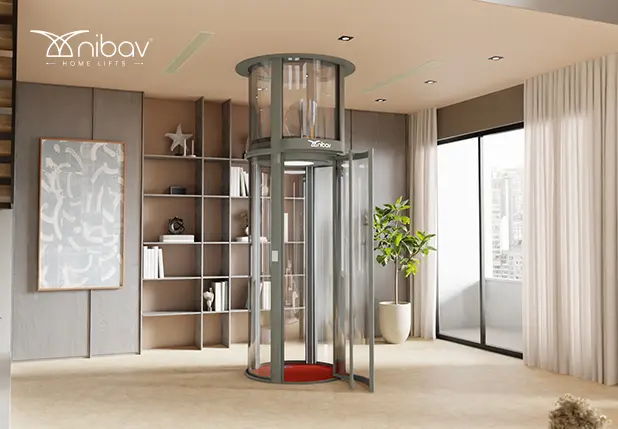
Small Inside Home Lift: Big Convenience in Compact Spaces
A small inside home lift is a compact residential elevator designed to provide convenient movement between floors while using limited indoor space. It can be particularly useful for homeowners who want improved accessibility. Nibav Home Lifts offers residential lift solutions designed for different home layouts and space requirements.
When every square foot of a home matters, adding a lift can seem impractical. Homeowners may worry about losing valuable living space, making structural changes or dealing with a lengthy installation process. Yet as homes become more vertically designed, convenient access between floors is becoming an increasingly important consideration. This is where a small inside home lift can make a meaningful difference without demanding a large footprint.
A mini home elevator can provide everyday convenience across multiple levels, while a compact indoor lift can be considered for homes where available space is limited. Depending on the property’s layout, a small residential elevator can also support accessibility for seniors, family members with mobility challenges and homeowners planning for long-term convenience.
However, choosing a space-saving home lift involves more than simply finding the smallest available model. Capacity, safety, installation requirements, travel height, maintenance and the home’s existing structure all need to be evaluated. This guide explores what homeowners should know when considering a compact lift and how to determine whether it is suitable for their home.
Table of Contents
▾Who Actually Uses A Small Residential Elevator Inside A House?
Ask any household a year after installation, and the answer is almost always “everyone.” The lift stops being a medical device within about a month and becomes infrastructure.
Some of what it ends up doing:
Carrying things, not just people: Groceries from the car, laundry between floors, suitcases before a trip, water cans, a vacuum cleaner. These are the trips that quietly cause most household falls, and they are the trips a stairlift cannot help with at all.
Carrying Two people at once: A parent with an attendant, a grandparent with a grandchild, a couple going up together. This is why the smallest Nibav Home Lifts cabin, the Series III Standard at 749 mm, is rated at 210 kg (462 lbs) for two passengers rather than one.
Late-night trips: Which is why what happens during a power cut matters more than any other specification.
Guests: An older visitor who would otherwise be confined to the ground floor.
Here is how each of those translates into something to ask for.
| What the household will actually do with it | Why it matters | What to specify |
| Carry groceries or laundry with both hands full. | Door operation becomes the difficulty, not the travel. | 508 mm clear door opening; AutoGlide™ sensor-based automatic landing doors on Series V |
| Short, frequent trips between two floors | Waiting for the cabin to arrive discourages use. | Programmable Auto Return to a preferred floor |
| An elderly user travelling with an attendant | One-person cabins fail exactly when needed. | Minimum 210 kg (462 lbs), two passengers |
| A wheelchair, now or within ten years | The cabin cannot be widened later. | Max variants: 1,240 mm cabin, 240 kg (529 lbs) |
| Children using it unsupervised | Unauthorised operation | Child-safety switch and multi-layered door interlocks |
| Use during a power cut, at night | Nobody should wait for a technician. | Automatic descent to ground level, manual door opening, battery backup, GSM cabin phone |
| A user who dislikes enclosed spaces | An avoided lift is wasted money. | 360-degree panoramic cabin in polycarbonate |
Where Does a Compact Indoor Lift From Nibav Home Lifts Go?
The honest answer for most Indian homes is: somewhere you are already not using.
A compact indoor lift fits comfortably in a stairwell void, the space between flights that is dead by definition and runs the full height of the house. Failing that, a corner of the living or dining room works, helped by the fact that a transparent cabin does not block sightlines the way a solid column would. An internal courtyard, a lightwell, or a deep car porch are the next options, and several Nibav Home Lifts customers have installed at the car park without losing a parking space.
Whichever you choose, measure the actual clear circle rather than the wall-to-wall dimension. Skirting, pipe boxing, a beam drop or a door swing all eat into it. Then check floor-to-floor height against the 2,436–2,800 mm minimum headroom, which most homes clear comfortably but a sloped terrace slab may not.
What a Mini Home Elevator Needs From Your House?
Less than most people expect, and this is where a mini home elevator differs fundamentally from a conventional one.
- The Series IV and Series V need 1,010 mm of clear space, about 8.5 sq ft. The Series III Standard needs roughly 1,010 mm. The wheelchair-capable Max variants need 1,430 mm. For comparison, that is a footprint similar to a large armchair.
- The self-supporting hybrid shaft of aluminium, galvanised steel and polycarbonate stands on your existing floor, so there is no pit, no machine room, no RCC shaft and no load-bearing modification. Site work is limited to marking the footprint and cutting a clean opening through each intermediate slab, with no separate civil works contract.
- A single-phase point drawing roughly 3.7 kVA while ascending, with zero power while descending. No three-phase sanction.
- Installation typically completes in 24 to 48 working hours, because the unit arrives semi-assembled.
- The specification worth comparing across brands is ROS, or Return on Space: the share of footprint returned as usable cabin. Series IV and Series V achieve 72%, and the Max variants 77%.
How Does A Nibav Home Lift Space-Saving Small Inside Home Lift Work?
A space-saving small inside home lift of this type is air-driven. The cabin travels inside a sealed cylinder as air pressure above it is reduced to lift it and released to lower it. There is no counterweight, no hoist rope, no gearbox and greaseless, which is why no machine room is needed and why maintenance is light.
It also explains the safety behaviour. Loss of pressure produces a controlled descent rather than a drop, and the layered protections cover the rest: automatic descent to ground level on power failure with manual door opening, an emergency landing switch fitted inside and outside the cabin, the Sure Stop system which locks the cabin within 2 inches if pressure drops or speed exceeds safe limits, conventional manual door unlock, the Rapid Rescue Latch (RRL), AUX battery backup for light, fan, alarm and the GSM cabin phone, and a child-safety switch with multi-layered door locking.
Nibav Home Lifts home elevators are TÜV NORD certified, engineered to comply with European safety standards, with the company also holding ISO 14001 and ISO 45001 certification. Operating noise on the Series III Standard is around 55 dB, with soundproof and split-unit options where the lift sits near a bedroom. Units ship Completely Knocked Down (CKD) and can be dismantled and reinstalled if you move.
FAQs
What does a mini home elevator cost in India?
Nibav Home Lifts models start at ₹11.99 lakhs for the Series III Standard, with the Series III Max at ₹14.99 lakhs, Series IV at ₹16.69 lakhs, Series IV Max at ₹19.69 lakhs, Series V at ₹19.49 lakhs and Series V Max at ₹22.49 lakhs. Prices exclude applicable taxes and vary with stops, cabin size and finishes.
How many people can a small residential elevator carry?
Nibav Home Lifts Standard models carry 210 kg, around two adults. The Max variants carry 240 kg for three to four passengers and support wheelchair travel with an attendant.
Can a compact indoor lift be installed in an existing house?
Yes. Nibav Home Lifts uses a zero-pit, self-supporting hybrid shaft standing on the existing floor, so no structural modification is needed and installation typically takes 24 to 48 working hours. The CKD design also allows relocation.
Is a space-saving home lift safe during a power cut?
Yes. The cabin performs an automatic descent to ground level and the door opens manually, so no technician is needed. Battery backup keeps the light, fan, alarm and GSM cabin phone live, and an emergency landing switch is fitted inside and outside the cabin.
Is a small home lift better than a stairlift?
For most households, yes. A stairlift is cheaper but occupies the staircase permanently and cannot carry a wheelchair, laundry or shopping. A Nibav Home Lifts Series III Standard needs about 8.6 sq ft, leaves the stairs clear, and serves up to 4 stops (G+3).
Author
No comments yet.