 By shanmugapriya on August 17, 2026
|
By shanmugapriya on August 17, 2026
|



How to Choose the Best House Elevator Lift for Your Home
Table of Contents
▾- Introduction
- Start With Your Space, Not the Elevator
- Matching Elevator Type to Your Home
- When a Home Elevator Small Footprint Makes Sense
- Capacity: How Many People Will Actually Use It?
- Safety Features That Should Be Non-Negotiable
- Installation: What to Expect and How Long It Takes
- Certifications Worth Checking
- Understanding Real Cost of Home Elevators
- Questions to Ask Before You Sign
- Why Nibav Home Lifts Is a Trusted Choice
- Conclusion
- Frequently Asked Questions
Introduction
Buying a house elevator lift isn’t like buying an appliance — it’s closer to a small construction decision, because it changes how your home moves people between floors for years to come. Among elevators for homes, the sheer variety of types, sizes, and price points can make the decision feel overwhelming, especially if this is your first time evaluating one.
This guide breaks the decision down into the pieces that actually matter: how to judge space requirements (including when a home elevator small footprint is the right call), what installation really involves, which safety features are non-negotiable, and how pricing typically works out once you account for everything beyond the sticker number.
Start With Your Space, Not the Elevator
Most people begin their search by browsing elevator models. That’s backwards. The smarter starting point is measuring what your home can actually accommodate — because space constraints eliminate options faster than any brochure comparison will.
Walk through your home and note:
- Available floor footprint at each level where the lift will pass through
- Total travel height from the lowest to the highest floor you want served
- Overhead clearance at the top floor
- Whether the same footprint is clear on every floor — a lift needs vertical alignment
Once you know these numbers, you can shortlist elevator types instead of models — and that’s a much shorter, more useful list.
Matching Elevator Type to Your Home
| Home Situation | Best-Suited Elevator Type | Why |
| Existing home, limited space, retrofit | Self-supporting pneumatic | No pit, no shaft, no machine room |
| New construction with dedicated shaft planned | Traction (cable-drive) | Efficient for taller travel heights |
| Priority on higher weight capacity | Hydraulic or Max-series pneumatic | Handles heavier loads well |
| Frequent wheelchair access needed | Max-series pneumatic with wider cabin | Wider doors, more internal cabin diameter |
If you’re retrofitting an existing home — which describes most Indian buyers — self-supporting elevators solve the two biggest pain points at once: minimal structural disruption and a fast timeline, with installation completed in 24-48 working hours once the site is ready.
When a Home Elevator Small Footprint Makes Sense
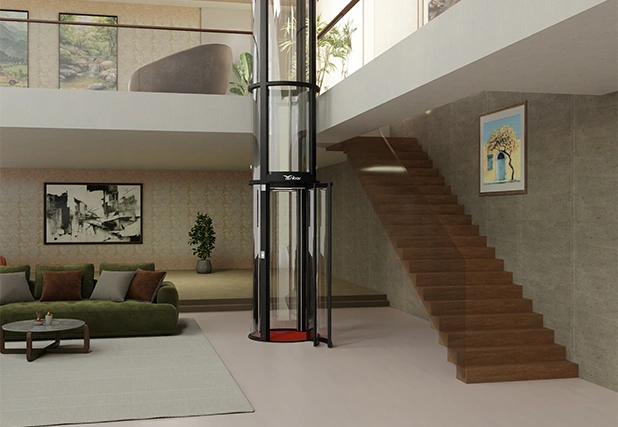
Not every home has room to spare, and that’s exactly where a home elevator small enough to fit a tight utility corner or stair landing earns its place. Compact pneumatic models are engineered specifically for this — a 3 ft x 3 ft footprint is often enough to serve two people comfortably, without the shaft, pit, or machine room a larger system would demand.
The trade-off with going smaller is capacity: a compact cabin suits daily two-person use well but may feel tight for wheelchair access or frequent furniture-moving. If either of those is a regular need, it’s worth sizing up even if space is limited — a Max-series cabin still installs without civil work, just with a slightly larger footprint.
Capacity: How Many People Will Actually Use It?
It’s tempting to buy the biggest cabin available, but capacity should match actual daily use, not worst-case scenarios.
Rough capacity guide:
- 2-person / everyday use: Rated capacity around 210 kg, internal cabin diameter around 830 mm
- 3-4 person / family or wheelchair access: Rated capacity around 240 kg, internal cabin diameter around 1160-1240 mm
A larger cabin does add cost and, in some cases, a slightly larger footprint requirement — so it’s worth being honest about whether you need it for daily use versus occasional guests.
Safety Features That Should Be Non-Negotiable
Regardless of elevator type or budget, these safety layers should be present and clearly explained by any supplier:
- Automatic descent during power failure — the cabin moves safely to the nearest or ground floor
- Emergency landing switch — accessible inside and outside the cabin
- Overload and speed-safety lock system — halts the lift if weight or speed limits are exceeded
- Door interlocks and sensors — prevent movement unless doors are fully closed
- Manual rescue access — allows safe access for rescue personnel in rare emergencies
If a supplier can’t name these features specifically — not just say “it’s safe” — treat that as a gap worth pressing on.
Installation: What to Expect and How Long It Takes
Self-supporting pneumatic elevators:
- Site survey and floor-strength check
- Core-cutting between floors (no beams or load-bearing walls broken)
- Modular cabin and shaft assembly
- Electrical connection (standard single-phase power)
- Safety testing
- Handover — typically completed in 24-48 working hours in India once the site is prepped
Traction or shaft-based elevators require masonry shaft construction, pit preparation, and more extensive electrical work — often extending to several weeks depending on civil work needed.
Certifications Worth Checking
Ask suppliers directly which certifications their elevators carry, and verify them rather than taking marketing copy at face value.
- ISO — quality management system certification
- TÜV NORD certification — third-party engineering and safety verification
- International safety compliance relevant to home-use lift systems
A supplier that can produce these certificates on request, rather than just listing them on a webpage, is generally a safer bet.
Understanding Real Cost of Home Elevators
House elevator lift pricing varies by series, cabin size, and number of stops (floors served). As a reference point, indicative starting prices for a single-stop (G+1) configuration typically range as follows:
| Series | Starting Price (G+1) |
| Series III | ₹11,99,000 |
| Series III Max | ₹14,99,000 |
| Series IV | ₹16,69,000 |
| Series IV Max | ₹19,69,000 |
| Series V | ₹19,49,000 |
| Series V Max | ₹22,49,000 |
Prices increase with additional stops (G+2, G+3), since more floors served means more shaft length and structural work. Always ask for a stop-specific quote rather than assuming the advertised “starting from” price applies to your exact home.
Questions to Ask Before You Sign
- What’s the exact rated capacity and internal cabin diameter for my planned use?
- Does the quote include installation, or is that billed separately?
- What civil work, if any, is required on my end?
- What does the warranty cover, and for how long?
- What’s the maintenance contract cost after the warranty period ends?
- Can I see a live installation similar to my home’s layout?
Why Nibav Home Lifts Is a Trusted Choice
Nibav Home Lifts focuses specifically on self-supporting pneumatic vacuum elevators engineered for Indian homes, with installation completed in 24-48 working hours and wheelchair-friendly cabin options across the Max series. The range is backed by ISO 9001:2015 and TÜV NORD certification, with safety layers including automatic descent, emergency landing switches, and rapid rescue latches built in as standard.
Conclusion
The right house elevator lift is the one that matches your home’s actual space, your household’s real usage pattern, and a supplier who’s transparent about specifications, safety, and total cost. Skip the model-first approach — start with your space and needs, and the right choice becomes obvious fast.
Ready to find the right fit for your home? Reach out for a free site assessment and get an exact specification and quote for your space.
Frequently Asked Questions
1.What size house elevator lift do I need for a 2-person household?
A compact model with around 210 kg capacity and roughly 830 mm internal cabin diameter comfortably serves two regular users.
2.Is a pit or machine room always required?
No. Self-supporting pneumatic elevators need neither, which is why they’re popular for retrofits in existing homes.
3.How long does installation typically take?
In India, self-supporting home elevators are typically installed within 24-48 working hours once the site is ready.
4.Do home elevators support wheelchair access?
Yes — Max-series models with wider cabin diameters and doors are designed to support wheelchair access.
Author
No comments yet.