
 By shanmugapriya on April 27, 2026
|
By shanmugapriya on April 27, 2026
|



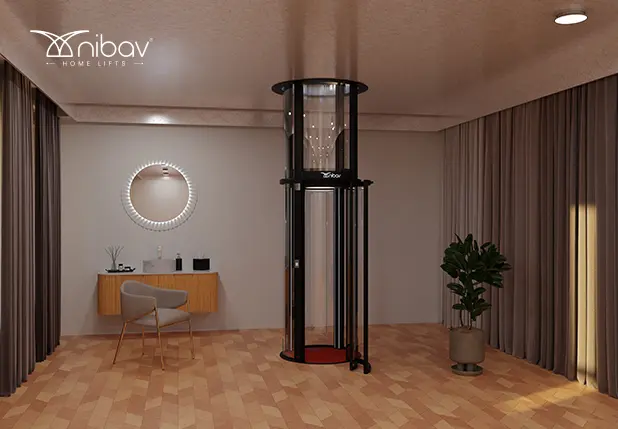
How Do Home Elevators Work? A Complete Breakdown of the Technology
What if the biggest limitation inside your home isn’t space but movement?
Across cities like Chennai, Bangalore, and Mumbai, homeowners are quietly shifting the way they think about comfort. Stairs, once a normal part of daily life, are now being questioned—not just for convenience, but for safety, long-term usability, and ease of living. And that’s where a common question begins to surface:
More importantly, people are beginning to ask a smarter version of that question—how home lifts work in a way that actually suits Indian homes, without heavy construction, high power usage, or complex machinery.
To understand the process, you don’t need an engineering background. You just need a clear explanation of the technology—and that’s exactly what this guide is built to offer, with a strong focus on how Nibav Home Lifts are redefining vertical mobility.
Table of Contents
▾- How Do Home Elevators Work?
- How Do Air-Driven Home Elevators Work?
- Why Traditional Elevator Systems Don’t Always Fit Indian Homes
- The Technology Behind Nibav Home Elevators
- How Nibav Models Apply This Technology Differently
- Comparison: Traditional Elevators vs Nibav Home Elevators
- Do Home Elevators Need a Pit?
- The Real Shift: From Limitation to Convenience
- The Emotional Side of the Decision
- Why Nibav Leads This Shift in India
- Make the Shift That Changes Everyday Living
- Frequently Asked Questions
How Do Home Elevators Work?
Home elevators work by moving a cabin vertically between floors using systems like hydraulic, traction, or pneumatic technology. In air-driven elevators, the lift operates using controlled air pressure, enabling smooth movement without cables, pits, or machine rooms.
Understanding How Home Elevators Work—Step by Step
Most explanations stop at “air pressure,” but that doesn’t really help you visualise what’s happening. So let’s walk through the actual process in a way that makes sense.
The moment you press a button inside a lift, the system activates a highly efficient turbine mechanism. This turbine begins to remove air from the top portion of the cylindrical lift structure. As air is gradually reduced above the cabin, a pressure difference is created—higher pressure exists below the cabin, and lower pressure exists above it.
This imbalance is what gently pushes the lift upward.
What makes this process impressive is how controlled it is. The lift doesn’t jerk or move abruptly. Instead, it glides upward smoothly, guided by precision-engineered systems that ensure stability and alignment at every level. Once it reaches the selected floor, the system calibrates the pressure and brings the cabin to a precise, safe stop.
Now, when it comes to descending, the process becomes even more efficient. Instead of consuming power, the system slowly reintroduces air into the chamber. Gravity assists the downward movement, while intelligent controls ensure that the descent is gradual and safe. This is why Nibav lifts consume energy only during ascent and require virtually no power to come down.
This entire process is what defines how home lifts work when powered by pneumatic technology—simple in concept, yet highly advanced in execution.
How Do Air-Driven Home Elevators Work?
Air-driven home elevators use vacuum technology to move between floors. By controlling air pressure above and below the cabin, the lift rises when air is removed and descends safely when air is reintroduced, using minimal energy and no cables.
Why Traditional Elevator Systems Don’t Always Fit Indian Homes
To fully appreciate this technology, it’s important to understand the limitations of conventional elevator systems.
Traditional elevators, especially hydraulic and traction-based systems, were originally designed for larger buildings. These systems often require deep pits, dedicated shafts, and separate machine rooms to function effectively. While they work well in commercial environments, they tend to create complications in residential settings.
In many Indian homes, space is already optimised. Introducing a system that demands structural changes can be both disruptive and expensive. Beyond that, these systems often consume more electricity, involve higher maintenance, and take weeks to install.
This is where the shift toward pneumatic elevators becomes not just logical but necessary.
The Technology Behind Nibav Home Elevators
Nibav Home Lifts are built around a core philosophy: simplify vertical mobility without compromising on safety or performance.
At the heart of every Nibav lift is its air-driven pneumatic system, which eliminates the need for cables, counterweights, and hydraulic fluids. This drastically reduces the number of moving parts, which in turn lowers maintenance requirements and improves long-term reliability.
Another defining advantage is the structural independence of the system. Unlike traditional elevators, Nibav lifts do not require a pit, shaft, or machine room. The entire unit is self-supporting, which allows it to be installed in both new constructions and existing homes without major modifications.
Energy efficiency is another area where this technology stands out. Because the lift uses power only while going up and relies on gravity for descent, it significantly reduces electricity consumption. In a country where energy efficiency directly impacts cost, this becomes a practical advantage—not just a technical feature.
Safety, however, remains the most critical aspect. Nibav integrates multiple layers of safety systems, including sure stop mechanisms, rapid rescue latch (RRL), automatic emergency descent, and multi-battery backup systems. These features work together to ensure that the lift operates safely even during power outages or unexpected situations.
How Nibav Models Apply This Technology Differently
While the core working principle remains the same, Nibav offers multiple models to suit different needs.
The Series III Standard, for instance, is designed for compact spaces. With a load capacity of 210 kg and the ability to carry two passengers, it fits comfortably into smaller homes without compromising functionality.
Moving further into premium territory, the Series IV and Series IV Max introduce upgraded technologies such as Motor 2.0, Quiet 3.0, and Suspension 2.0. These enhancements improve ride quality, reduce noise, and create a more refined user experience.
At the top of the range, the Series V and Series V Max represent Nibav’s most advanced offerings. With features like SmartConnect™, VividTouch™, and CoreShield™, these models combine intelligent controls, enhanced safety, and premium design to deliver a complete home mobility solution.
Comparison: Traditional Elevators vs Nibav Home Elevators
| Feature | Traditional Elevators | Nibav Home Elevators |
| Technology | Hydraulic / Traction | Air-driven pneumatic |
| Pit Requirement | Required | Not required |
| Machine Room | Required | Not required |
| Installation Time | 3–6 weeks | 24-48 working hours |
| Power Consumption | High | Low |
| Descent Power | Required | Zero power |
| Retrofit Capability | Limited | Highly suitable |
Do Home Elevators Need a Pit?
Traditional home elevators require a pit for installation. However, pneumatic home elevators like Nibav do not need a pit, shaft, or machine room, making them ideal for both new and existing homes.
The Real Shift: From Limitation to Convenience
For many homeowners, the hesitation isn’t about wanting a lift—it’s about what comes with it. Concerns about space, cost, safety, and installation complexity often delay the decision.
But when those barriers are removed, the perspective changes completely.
Nibav Home Lifts address these concerns at every level. They eliminate structural challenges, reduce energy usage, simplify installation, and enhance safety—all while fitting seamlessly into everyday life.
The Emotional Side of the Decision
Beyond the technology, there’s a human aspect that often gets overlooked.
It’s about making sure parents can move freely without assistance. It’s about removing the physical strain of climbing stairs every day. It’s about creating a home that adapts to your needs over time, rather than forcing you to adapt to it.
A home elevator, in this sense, is not just a convenience—it becomes part of how you experience comfort, independence, and long-term living.
Why Nibav Leads This Shift in India
Nibav has positioned itself as a global leader in air-driven home elevators, with its global presence in multiple countries and a workforce of more than 1000+ employees. Its systems are TÜV-certified and built to meet European safety standards, ensuring reliability and performance at a global level.
But what truly sets Nibav apart is how this global expertise is adapted specifically for Indian homes—where space, practicality, and efficiency matter the most.
Make the Shift That Changes Everyday Living
If you’ve been wondering how home elevators work, the better question now is, why wait to experience it?
With Nibav Home Lifts, you’re not just installing a lift. You’re upgrading the way your home functions.
Book a free consultation today and discover how a Nibav lift can be installed in your home—without structural changes, without long timelines, and without compromise.
Frequently Asked Questions
1. How do home elevators work without cables?
Nibav home elevators use air pressure instead of cables. By creating a vacuum above the cabin, the lift moves upward, while controlled air release ensures a smooth and safe descent.
2. Do home lifts consume a lot of electricity?
No, Nibav lifts are designed to be energy-efficient. They use electricity only during ascent and consume minimal power overall.
3. Can home elevators function during power cuts?
Yes, Nibav elevators include battery backup systems and automatic emergency descent features, ensuring safe operation even during power failures.
4. Are home elevators suitable for existing homes?
Yes, since Nibav lifts do not require a pit, shaft, or machine room, they can be easily installed in existing homes.
5. How long does installation take?
Installation typically takes between 24-48 working hours, depending on the model and site conditions.
6. Which model is best for families?
Models like the Series III Max and Series IV Max are ideal for families due to their higher capacity and spacious cabin design.
Author
 Sriram
I'm Sriram, part of the Research & Development team. I specialize in home lift technology, working closely on innovations that make our elevators safer, more efficient, and better suited for modern homes. My role involves everything from testing new features to fine-tuning the performance of our latest lift models.

Vivek Kulkarni
This blog explains how home elevators work in a very simple and practical way. I liked the step-by-step explanation of air pressure and how it helps the cabin move between floors. The details about safety features, energy efficiency, and installation also make the article useful for homeowners who are researching modern home elevators.
Meenal Joshi
A very informative read for anyone trying to understand home elevator technology. The explanation of how home elevators work without conventional cables was particularly interesting. I also liked the comparison between traditional and pneumatic systems because it clearly explains the differences in installation, space requirements, and power usage. Overall, this is a helpful guide for first-time buyers.
Sandeep Bhatia
I found this article genuinely helpful because it explains the technology behind home elevators without making it difficult to understand. The sections covering air pressure, controlled descent, battery backup, and safety systems provide useful information. The article also answers common questions clearly, making it a good resource for homeowners who want to learn how home elevators work before exploring their options.
Ritu Malhotra
This is a well-structured explanation of how modern home elevators function. I especially liked how the article explains the role of pneumatic technology and why these systems can be suitable for existing houses. The information about avoiding a pit, shaft, and machine room was useful as well. Anyone researching home elevators can gain a much clearer understanding from this content.
Nikhil Deshmukh
A useful and detailed article for homeowners who are curious about home elevators. The explanation of how air pressure moves the cabin makes the working principle much easier to understand. I also found the sections on energy consumption, emergency features, and different models valuable. This blog gives a good overview for anyone searching for practical information on how home elevators work.