 By shanmugapriya on September 22, 2026
|
By shanmugapriya on September 22, 2026
|



What Adds To The Cost Of Installing A Lift At Home In Bangalore?
When planning a home elevator, the quoted price is rarely the whole story. Two homeowners in Bangalore can receive very different estimates for what appears to be a similar lift because factors such as the number of floors, elevator technology, shaft requirements, cabin specifications, and site conditions can significantly influence the final investment. Current Bangalore pricing guides similarly identify floor count, shaft or structural work, technology, and customisation among the key cost drivers.
For homeowners researching the home elevator installation cost in Bangalore, understanding what goes into the quotation is just as important as knowing the starting price. An apparently affordable quote may exclude civil work, electrical preparation, structural modifications, or design upgrades, making it difficult to compare options accurately.
So, what actually adds to the cost of installing a lift at home in Bangalore? From the type of elevator and number of stops to installation complexity and cabin customisation, this guide breaks down the major factors that can affect your budget and helps you understand what to look for when evaluating a home elevator quotation.
Table of Contents
▾- Home Elevator Installation Cost In Bangalore: Where The Base Price Starts
- What Are The Factors That Influence The Home Elevator Installation Cost In Bangalore?
- What Are The Civil Work Lines That Disappear With Nibav Lifts?
- What Kind Of Customisation And Site Conditions Affect Home Elevator Installation Cost In Bangalore?
- What Nibav Lifts Home Elevators Cost After Installation
- FAQs
Home Elevator Installation Cost In Bangalore: Where The Base Price Starts
Nibav Lifts air-driven home elevators start at ₹11,99,000 for the Series III Standard and run to ₹22,49,000 for the Series V Max. Every model in that range serves up to 4 stops (G+3) with a maximum travel height of 13,500 mm (531 in), and all are TÜV NORD certified and engineered to comply with European safety standards, with the company also holding ISO 14001 and ISO 45001 certification.
That matters for cost comparison because certification and travel height are constant across the range. You are not paying more for a safer or taller lift. You are paying for the four things that follow.
What Are The Factors That Influence The Home Elevator Installation Cost In Bangalore?
Number of stops: More landings mean more cylinders, more doors and more installation time. Using the published Series V ladder as the clearest example: G+1 at ₹19,49,000, G+2 at ₹20,49,000, and G+3 at ₹22,49,000. So the second stop adds about a lakh, and the third about two. If you are undecided about whether the terrace becomes a landing, this is the number to weigh it against.
Cabin size and capacity: This is the largest single jump in the range. A Series IV at ₹16,69,000 gives you an 830 mm internal cabin rated at 210 kg. The Series IV Max at ₹19,69,000 gives you a 1,240 mm cabin at 240 kg. That roughly three lakh difference is what wheelchair access with an attendant costs. If a wheelchair is in the picture now or foreseeably, it is not optional, because a 749 mm or 830 mm cabin cannot be enlarged later.
Model tier: Series IV and Series V use the same 830 mm cabin and the same 1,000 mm footprint at 72% ROS, yet Series V starts at ₹19,49,000 against ₹16,69,000. The difference is automation and warranty, not size. Series V adds AutoGlide™ sensor-based automatic landing doors, GlideWide™ wide-opening cabin doors, the VividTouch™ touchscreen with integrated SmartConnect™ emergency communication, and CoreShield™, a 25-year warranty on the motor and vacuum seal.
What Are The Civil Work Lines That Disappear With Nibav Lifts?
This is the part of a Bangalore quote that most often gets missed, because it never appears on the lift supplier’s invoice. It appears on your contractor’s.
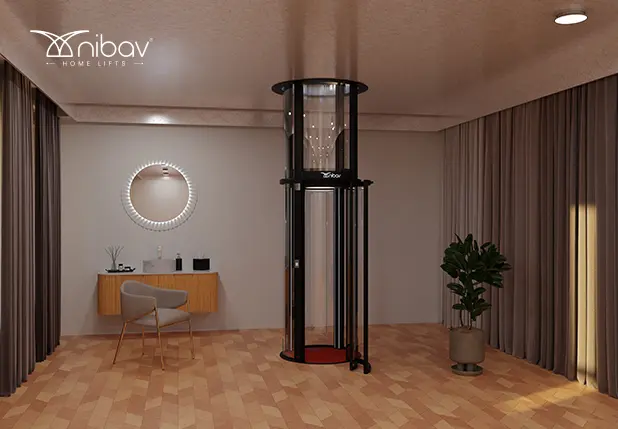
Nibav Lifts home elevators use a self-supported hybrid shaft built from aluminium, galvanised steel and polycarbonate glass rated at roughly 250 times the strength of ordinary glass. The structure carries itself and stands on your existing slab. That removes, in full:
- The pit. No excavation below the lowest landing.
- The machine room. The head unit sits above the shaft, with a split unit available where headroom is tight.
- The RCC shaft, columns and beam work. No load-bearing modification.
- The three-phase connection. Nibav Lifts runs on single-phase power, drawing about 3.7 kVA while ascending and zero power while descending.
What remains is marking the footprint and cutting slab openings. Installation typically completes in 24–48 working hours, because the unit arrives semi-assembled.
Two knock-on savings follow. Labour and site supervision costs scale with duration, so a five-day install does not carry the overhead of a five-week one. And in an occupied house, the shorter the disruption, the smaller the indirect cost of living around it.
Space required is modest: the Series III Standard needs about 1,010 mm of clear space, the Series IV and Series V need 1,000 mm, and the wheelchair-capable Max variants need 1,430 mm. Minimum headroom across the range is 2,436–2,800 mm.
What Kind Of Customisation And Site Conditions Affect Home Elevator Installation Cost In Bangalore?
Beyond models and stops, certain variables are smaller but still real. They include the following:
Finishes: The Series III offers 14 colour choices; Series IV and V extend to 20-plus across Standard, Textured, Metallic, Hydro Matt and Hydro Glossy editions. Premium New Zealand wool carpeting, leather base finishes and carbonic gloss highlights sit at the upper end.
Comfort and access add-ons: A leather foldable mono chair, leather-wrapped handles, handrails, and the Grande Edition, which raises cabin and door height by 170 mm for taller users.
Practical extras: Floor and ceiling cover plates, colour-matched earthquake brackets, and the choice between a split or built-in head unit, which is an installation-flexibility decision as much as a cost one.
Personalisation: Custom engraving of names, initials or patterns, plus ambient and mood lighting packages.
Site conditions: Older Bangalore properties on narrow streets can complicate delivery access, and slab condition occasionally needs attention. These are assessed at the feasibility visit rather than quoted blindly.
What Nibav Lifts Home Elevators Cost After Installation
After the installation of home elevators, the cost after installation covers the following:
Electricity: Single-phase supply, roughly 3.7 kVA on ascent, zero power on descent, because the controlled release of air does the work instead of a motor.
Maintenance: With no counterweight, hoist rope or gearbox, there are fewer wearing parts. The engineering is grease-free, which reduces routine servicing.
Support: Nibav Lifts services Indian installations through 500+ technicians and 40+ experience centres with 24-hour phone support.
Residual value: Each unit ships as a Completely Knocked Down (CKD) kit and can be dismantled and reinstalled, so the lift is an asset you own rather than a fixture that stays with the property.
FAQs
1. What is the home elevator installation cost in Bangalore?
Nibav Lifts home elevators start at ₹11,99,000 for the Series III Standard. The Series III Max starts at ₹14,99,000, Series IV at ₹16,69,000, Series IV Max at ₹19,69,000, Series V at ₹19,49,000 and Series V Max at ₹22,49,000. Prices exclude applicable taxes and vary with stops, cabin size, finishes and site conditions.
2. Does the number of floors change the price of a home lift?
Yes. Using the published Nibav Lifts Series V ladder, G+1 starts at ₹19,49,000, G+2 at ₹20,49,000 and G+3 at ₹22,49,000, so each additional stop adds roughly ₹100,000 to ₹200,000. Every model supports up to 4 stops (G+3) with a maximum travel height of 13,500 mm.
3. Is there extra civil work cost for a home elevator?
Not with a Nibav Lifts installation. The zero-pit, self-supported hybrid shaft needs no machine room, no RCC shaft and no load-bearing modification, so there is no separate civil contract for pit excavation or shaft construction. Site work is limited to marking the footprint and cutting slab openings, and installations typically complete in 24-48 working hours.
4. Does a home lift need three-phase power in Bangalore?
No. Nibav Lifts home elevators run on single-phase power, drawing roughly 3.7 kVA while ascending and zero power while descending, so no three-phase sanction or upgrade is required.
5. What are the running and maintenance costs?
Nibav Lifts air-driven elevators consume power only on ascent and none on descent, and with no counterweight, hoist rope or gearbox, there are fewer wearing parts to service. It supports Indian installations through 500+ technicians and 40+ experience centres with 24-hour phone support.
Author
No comments yet.