 By shanmugapriya on June 25, 2026
|
By shanmugapriya on June 25, 2026
|



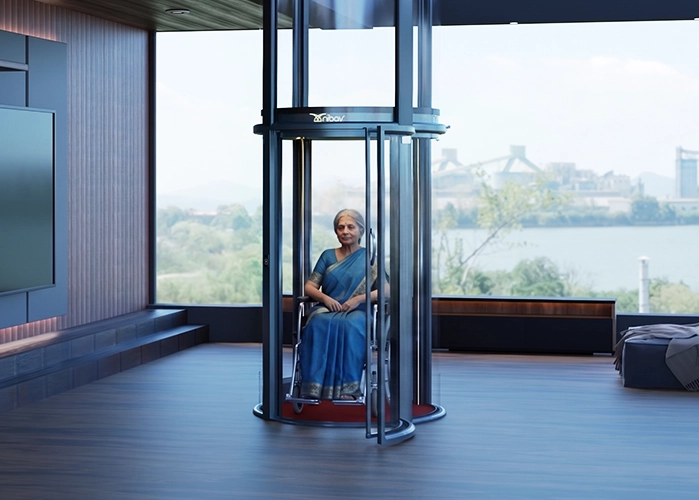
What Are the Advantages of Air-Driven Home Lifts? The Complete Guide
Every technology has its moment — the point when the engineering catches up to the need, the pricing becomes accessible, and a better solution becomes genuinely available to the people who need it. For Indian residential elevators, that moment belongs to air-driven home lifts.
For decades, the home elevator market in India was defined by hydraulic and traction systems — technologies borrowed from commercial buildings and adapted, with varying degrees of success, to residential use. They worked. But they worked on commercial buildings’ terms: requiring pits, machine rooms, structural shafts, professional servicing schedules, and installation timelines measured in weeks.
Then came vacuum (air-driven) technology — and the question stopped being “can I install a home elevator?” and started being “why haven’t I done this already?”
This guide covers every significant advantage of air-driven home lifts — why they represent a fundamentally better match for Indian residential conditions, and what that means in practical terms for homeowners across the country.
Table of Contents
▾- 1: No Pit, No Machine Room — Zero Civil Construction
- 2: 24–48 Hour Installation in Occupied Homes
- 3: Energy Efficiency — Zero Power on Descent
- 4: Performance During Power Cuts
- 5: Low Maintenance Requirements
- 6: Transparent Design That Enhances Home Interiors
- 7: Space Efficiency
- 8: Relocatability
- Why Nibav Home Lifts Represent the Best of Air-Driven Technology in India
- Frequently Asked Questions
- 1. What are the main advantages of air-driven home lifts over hydraulic lifts?
- 2. Are air-driven home lifts safe in India?
- 3. How much do air-driven home lifts cost in India?
- 4. Do air-driven home lifts require maintenance in India?
- 5. Can an air-driven home lift be installed in any existing Indian home?
1: No Pit, No Machine Room — Zero Civil Construction
The single most transformative advantage of air-driven home lift technology is the elimination of the civil infrastructure that made traditional lifts impractical for most Indian homes.
Air-driven lifts work on pressure differential — no piston below the cabin, no counterweight mechanism beside it, no cable drum to house. The result is a completely self-contained system that requires nothing from the surrounding structure except a floor to stand on and a ceiling to pass through.
What this means practically:
- No pit excavation: saves ₹1–3 lakhs in civil costs and eliminates the risk of excavation adjacent to existing foundations
- No machine room: saves ₹1–2.5 lakhs and recovers 4–8 sq metres of permanently dedicated floor area
- No structural shaft walls: saves ₹1–3 lakhs and eliminates weeks of masonry or steel construction
- Total civil work savings: ₹4–10 lakhs depending on city and site conditions
For existing Indian homes — the majority of installations — this is the difference between a practical investment and an impractical one.
2: 24–48 Hour Installation in Occupied Homes
A direct consequence of zero civil work requirements: air-driven home lifts install in 24–48 working hours.
This is not a minor convenience. For families living in occupied homes, the installation timeline is a quality-of-life question. A 3–6 week construction project means weeks of workers, dust, noise, and structural disruption in a home that people are simultaneously trying to live in normally. For elderly residents, young children, or anyone with health sensitivities, this is not acceptable.
24–48 hours means: the team arrives, the installation happens, the home is minimally disrupted, and the lift is operational within two working days. No extended construction. No prolonged disruption. No adjustment to the daily routine beyond a day or two.
3: Energy Efficiency — Zero Power on Descent
Air-driven home lifts have a fundamental energy efficiency characteristic that no other elevator technology can replicate: descent requires zero electricity.
When the cabin descends, the drive mechanism is gravity — the managed release of air through precision valves allows the cabin to lower at a controlled speed with no motor running. Power is consumed only during ascent.
4: Performance During Power Cuts
India’s power supply — particularly during monsoon season, in Tier 2 cities, and in areas with ageing infrastructure — is imperfect. Power interruptions are routine. For a home elevator, how it behaves during a power cut is not a theoretical safety question; it is a practical daily-use consideration.
Air-driven home lifts handle power interruptions automatically and safely:
- Power cuts → turbine motor stops
- Controlled air valves open passively (no power required)
- Cabin descends to nearest floor under gravity
- Battery backup maintains cabin lighting, ventilation, and door operation
- Doors open normally — passengers exit safely
No technician required. No manual lowering procedure. No passengers stranded in the dark between floors. The physics of the system — gravity and atmospheric pressure — provide the emergency descent mechanism naturally.
This behaviour is automatic, consistent, and requires no action from the passenger. For homes with elderly residents or children, it is a genuine safety reassurance that traditional systems often cannot match without expensive additional backup equipment.
5: Low Maintenance Requirements
The mechanical simplicity of air-driven home lifts is a long-term financial advantage that most buyers underestimate at the point of purchase.
Traditional hydraulic lifts require: regular fluid checks, fluid seal inspections, periodic fluid changes, machine room component servicing, and hose replacements over the system’s life. In India’s climate — coastal humidity in Chennai and Mumbai, extreme heat in Hyderabad and Delhi — fluid-based systems face accelerated degradation that increases maintenance frequency and cost.
Air-driven lifts have: no hydraulic fluid, no fluid seals, no fluid changes, no machine room components. The primary maintenance items are the turbine motor and the vacuum seal — which some manufacturers back with extended warranties on motor and seal up to 25 years on their top-tier models.
Standard AMC Charges for lifts range between 3-5% of lift prices, scope of contract coverage, location.
6: Transparent Design That Enhances Home Interiors
The transparent polycarbonate shaft of an air-driven home lift is an aesthetic advantage with no direct equivalent in hydraulic or traction systems.
An opaque shaft — whether masonry or steel — creates a visual mass in whatever space it occupies. It blocks light, creates a shadowed zone, and reads as a structural intrusion in an interior.
A transparent polycarbonate shaft does the opposite: light passes through, sightlines remain open, and the elevator integrates into the surrounding space as a visual feature rather than an obstruction. For premium Indian homes where interior aesthetics are carefully considered, this is a meaningful design advantage.
Cabin interiors in air-driven lifts from premium manufacturers offer leather finishes, ambient lighting, touchscreen controls, personalised engraving, and customisable colour options — elevating the lift from a functional installation to a design statement.
7: Space Efficiency
The combination of self-supporting shaft and no machine room makes air-driven home lifts the most space-efficient residential elevator technology available.
Total footprint: 1010–1430 mm clear floor diameter depending on model. No surrounding machine room. No pit space below. In compact Indian homes on small urban plots, this space efficiency is not a minor detail — it is what makes installation practically possible in homes where traditional systems could never fit.
8: Relocatability
Most Indian families move homes at some point. Traditional elevator installations cannot be moved — the pit, machine room, and shaft walls are permanently fixed to the building’s structure. The investment stays with the property.
Air-driven home lifts with modular CKD (Completely Knocked Down) design can be dismantled and reinstalled in a new property. The investment moves with the family — an unusual and genuinely valuable financial characteristic for a major home infrastructure purchase.
Why Nibav Home Lifts Represent the Best of Air-Driven Technology in India
Every advantage described in this guide is delivered by Nibav’s air-driven home elevator range — and in the Series V models, extended further with smart features available nowhere else in India.
TÜV NORD Certification across the full range. 24–48 working hours installation. Zero civil work. Automatic emergency descent. Battery backup. No hydraulic fluid. Transparent panoramic design. 24+ colour and finish options.
The Series V Standard and V Max add: auto-opening AutoGlide™ doors, SmartConnect™ integrated emergency communication, HeartLine™ laser-engraved personalisation, SkyMark™ illuminated ceiling, ZeroTrace™ screwless exterior, and CoreShield™ 25-year warranty on motor and seal.
For Indian homeowners evaluating air-driven home lifts — Nibav is the brand that has built its entire product philosophy around making this technology work for Indian homes, Indian families, and Indian conditions.
Frequently Asked Questions
1. What are the main advantages of air-driven home lifts over hydraulic lifts?
No pit, no machine room, 24–48 working hours installation, zero power on descent, automatic power-cut safety, no hydraulic fluid maintenance, and transparent design that enhances home interiors. For Indian residential applications, air-driven technology outperforms hydraulic on every practically relevant dimension.
2. Are air-driven home lifts safe in India?
Yes — TÜV NORD Certified air-driven home lifts are independently verified against European safety standards. Built-in safety systems include automatic emergency descent, battery backup, triple-layer door detection, overload protection, and child safety controls.
3. How much do air-driven home lifts cost in India?
Entry-level models start at ₹11,99,000 for a G+1 installation (all-inclusive, no civil work additions). Premium flagship models start at ₹19,49,000. Prices are starting rates, excluding taxes.
4. Do air-driven home lifts require maintenance in India?
Yes — but significantly less than hydraulic alternatives. No fluid changes, no fluid seal inspections, no machine room servicing. Some manufacturers offer 25-year warranties on core components (motor and seal) on their top-tier models.
5. Can an air-driven home lift be installed in any existing Indian home?
In most cases, yes. The self-supporting, pitless design works in existing occupied homes with standard floor structures and ceiling heights. A site assessment confirms suitability for specific homes.
Author
No comments yet.