 By shanmugapriya on October 8, 2026
|
By shanmugapriya on October 8, 2026
|



Transparent Home Elevators: Why They’re the First Choice for Modern Luxury Homes
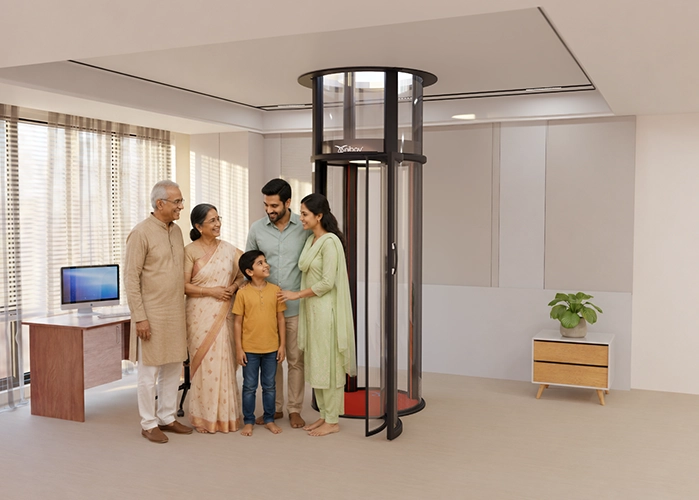
Luxury homes are increasingly designed around openness, natural light and seamless movement. Yet a conventional elevator can introduce a bulky shaft, enclosed cabin and heavy visual presence that works against that vision. For homeowners investing in a carefully designed villa, that is more than a minor inconvenience: the lift can become the one element that feels added rather than integrated. The answer is not simply a prettier elevator, but a transparent home elevator designed to contribute to the architecture. Panoramic cabins, compact footprints and self-supporting options can make vertical mobility part of the home’s visual language while also supporting everyday accessibility. This guide is aimed at luxury homeowners, architects, interior designers and families planning long-term mobility.
Table of Contents
▾- Why Transparent Home Elevators Suit Luxury Architecture
- Panoramic Home Lift Design: More Than an Aesthetic Feature
- Glass Lift for Home vs Transparent Polycarbonate Cabin
- What to Check Before Buying a Luxury Home Elevator
- Transparent Home Elevator Cost: What Changes the Price?
- Why Nibav Home Lifts Stand Out for Modern Homes
- Nibav Home Lift Range for Luxury Residences
- Nibav Home Lifts: Model Guide
- Frequently Asked Questions
- A Practical Next Step
Why Transparent Home Elevators Suit Luxury Architecture
A luxury home is judged as much by proportion and visual continuity as by individual products. A transparent or panoramic lift can preserve sightlines between levels instead of creating the enclosed feeling associated with a conventional cabin. That makes it relevant to villa owners and designers working with double-height spaces, open staircases and statement interiors. It can also serve families with older parents or anyone planning for future accessibility. The key is to choose a lift whose structure, doors, lighting and finishes complement the architecture rather than compete with it.
Panoramic Home Lift Design: More Than an Aesthetic Feature
The appeal of a panoramic home lift begins with visibility, but its practical value goes further. A transparent cabin can make a journey feel more open and can visually reduce the presence of the lift. For a designer, this creates flexibility around staircases, living areas and transitional spaces. For a homeowner, the elevator can become an architectural feature rather than an enclosed service element. Buyers should still evaluate cabin dimensions, door arrangement, privacy, lighting, cleaning and maintenance before selecting a model.
Glass Lift for Home vs Transparent Polycarbonate Cabin
When buyers search for a glass lift for home, they often mean a visually open elevator rather than a specific construction material. True glass cabins can create a premium appearance, but the enclosure material, structural design, doors and safety systems should all be considered. Nibav uses high-strength polycarbonate in its panoramic systems, creating a transparent appearance within a lightweight residential structure. Material choice should therefore be judged alongside durability, maintenance, installation and the home’s intended location.
What to Check Before Buying a Luxury Home Elevator
- Space and placement: confirm the footprint, landing clearances and headroom before finalising the lift location. A compact elevator may fit beside a staircase or in another planned position, but the exact site must be assessed.
- Technology: compare pneumatic, hydraulic, traction and other residential technologies on installation requirements, energy use, maintenance and capacity rather than choosing purely on appearance.
- Safety: look for documented emergency operation, door protection, locking or braking mechanisms and relevant certification.
- Accessibility: consider whether the cabin will remain useful as family needs change. A larger configuration may be worthwhile for wheelchair access or an attendant.
- Customisation: compare colours, finishes, lighting, doors and interior detailing, and confirm which options are included in the quotation.
Transparent Home Elevator Cost: What Changes the Price?
The cost of a luxury residential elevator depends on technology, number of stops, cabin size, capacity, installation conditions and customisation. Structural work, electrical requirements, doors and interior finishes can affect the final amount. Buyers should request a complete configuration rather than comparing headline prices alone. A clear quotation should identify the model, including features, taxes, installation scope and optional upgrades. Long-term service and maintenance should also form part of the decision.
Why Nibav Home Lifts Stand Out for Modern Homes
Nibav Home Lifts focuses on air-driven pneumatic residential elevators built around compact, self-supporting structures. Its current India product information states that the systems do not require a conventional pit or machine room and can be considered for new and existing homes. The range includes panoramic cabins and standard and larger configurations for different space and accessibility needs. Nibav also states that its systems use approximately 3.7 kVA during ascent and practically zero electricity during descent.
Nibav Home Lift Range for Luxury Residences
Nibav offers six home-lift series, from the compact Series III to the larger Series V Max. Series III Standard is positioned as a compact two-passenger option, while Series III Max adds capacity and a wheelchair-friendly configuration. Series IV and IV Max provide further space and smart features, while Series V and V Max sit at the premium end with enhanced interior and accessibility features. The India pricing supplied for this project ranges from ₹11,99,000 to ₹26,09,000, excluding applicable taxes.
Nibav Home Lifts: Model Guide
| Model | Positioning | Key details |
| Series III | Compact residential mobility | 210 kg; up to G+3 |
| Series III Max | Larger accessibility-oriented option | 240 kg; wheelchair-friendly configuration |
| Series IV | Compact premium option | Panoramic design and smart features |
| Series IV Max | Spacious accessible option | Up to 240 kg; wider entry |
| Series V | Premium design-focused lift | HeartLine™, SkyMark™ and AutoGlide™ features |
| Series V Max | Spacious luxury configuration | Wheelchair access with attendant; SmartConnect™ |
Frequently Asked Questions
Are transparent home elevators safe?
Safety depends on the complete elevator system, not simply whether the cabin is transparent. Evaluate the enclosure, doors, locking or braking systems, emergency operation, communication and certification.
Are glass elevators suitable for luxury villas?
Yes. Panoramic elevators can complement villas where open sightlines and interior design are priorities. The installation still needs to be assessed for space, headroom and access.
Do transparent home elevators need a machine room?
Requirements depend on the technology. Nibav pneumatic home lifts are self-supporting and designed without a conventional pit or machine room, subject to site suitability.
How much does a luxury home elevator cost in India?
There is no single price. Nibav’s supplied India range for this project is ₹11,99,000 to ₹26,09,000, excluding applicable taxes.
Who is a transparent home elevator best suited for?
Typical audiences include luxury villa owners, architects, interior designers, multi-generational families and homeowners planning easier movement between floors.
A Practical Next Step
Start with the architecture, not the product catalogue. Measure the available space, identify the floors to be connected, define accessibility needs and then compare technologies and configurations. A good residential elevator should look right in the home and remain practical for years.
Author
No comments yet.