 By shanmugapriya on September 21, 2026
|
By shanmugapriya on September 21, 2026
|



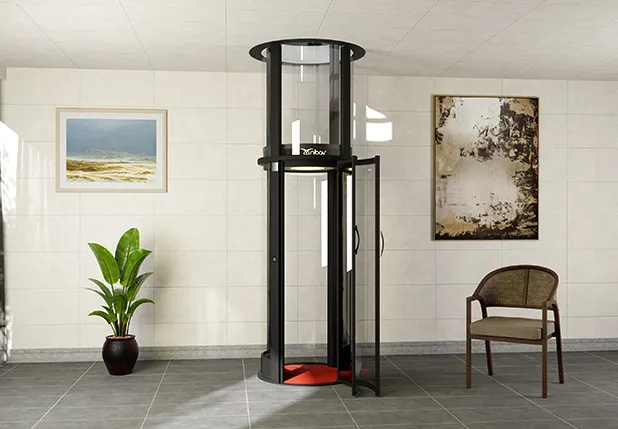
Small Elevator Lifts For Vijayawada Homes: Space-Saving Options Explained
A home elevator can sound like a major addition when space is already at a premium. In compact Vijayawada homes, homeowners may hesitate to consider a lift because of concerns about losing usable floor area, extensive structural work, or disrupting the existing layout.
However, modern residential lift designs are increasingly focused on space-efficient installation, with some solutions designed to work without a conventional pit, shaft, or machine room. Nibav’s Vijayawada offerings, for example, highlight compact designs and minimal civil work as part of their residential elevator approach.
For homeowners exploring small home elevators in Vijayawada, the real question is not simply whether a lift will fit, but how well it can integrate into the home’s existing architecture. Factors such as available floor space, number of stops, installation requirements, safety, accessibility, and overall design should be considered before making a decision.
This guide explores the space-saving elevator options available for Vijayawada homes and the key factors homeowners should consider when choosing a compact lift that delivers convenience without overwhelming their living space.
Table of Contents
▾- What Actually Limits A Home Lift In Vijayawada Houses?
- What Are The Five Places Where Small Home Elevators In Vijayawada Can Fit?
- How Nibav Lifts Keeps The Footprint This Small?
- How Nibav Lifts Handles Vijayawada’s Heat and Power Cuts?
- What Are The Safety And Certifications Of Reliable Small Elevator Lifts?
- FAQs
What Actually Limits A Home Lift In Vijayawada Houses?
A traditional shaft consumes floor area on every level it passes through. In a G+3 house, a 1.8-metre shaft can take 30 to 40 square feet per floor. A pneumatic lift behaves differently in three ways that matter for placement:
- It carries its own structure. The shaft is the lift, built from aluminium, galvanised steel and polycarbonate glass panels rated at roughly 250 times the strength of ordinary glass. It stands on the existing slab and bolts to nothing structural.
- It needs no pit. Nothing is excavated below the lowest landing, so the ground floor slab stays intact.
- It is transparent. A panoramic cabin in the middle of a living room does not read as a solid column blocking the room. Sight lines pass through it.
Together those three properties open up locations no architect would have offered you for a traction lift.
What Are The Five Places Where Small Home Elevators In Vijayawada Can Fit?
Here are the placements that work most often in Vijayawada’s independent houses, in rough order of how frequently they get used.
| Placement | Typical suitability | What to check | Likely model fit |
| Stairwell void (the open well between flights) | Very common in G+2 and G+3 houses | Whether the well is a true circle of 1,010 mm clear, after handrails | Series III Standard or Series IV |
| Corner of the living or dining room | Common in wider plots | Door swing, skirting and furniture clearance | Series IV or Series V |
| Car porch or parking area | Frequently used where the porch is deep | Vehicle turning circle; slab above the porch | Series IV or Series IV Max |
| Internal courtyard or open-to-sky area | Older Vijayawada houses often have one. | Rainwater drainage and a roof over the head unit | Any model, subject to weather protection |
| Against an external wall, outside the built footprint | Where nothing internal works | Setback and boundary distances under local rules | Series IV Max or Series V Max |
The stairwell void is the placement most homeowners overlook and the one that most often works. It is dead space already, it runs the full height of the house by definition, and it puts the lift beside the stairs, which is where people instinctively look for it.
The car porch deserves a mention too. Nibav Lifts customers have reported G+3 installations sited at the car park without losing parking, because the lift footprint of roughly one square metre sits in space a vehicle was never occupying anyway.
The one placement that needs care is the courtyard. It is usually the easiest space to give up, but the head unit needs weather protection, and drainage has to be routed clear of the footprint.
How Nibav Lifts Keeps The Footprint This Small?
The number to compare across brands is ROS, or Return on Space: usable cabin as a proportion of total footprint. A lift that needs 1,800 mm of floor to deliver a 900 mm cabin is wasting space you do not have.
Two engineering choices produce those ratios. The unicylinder design maximises usable cabin within a given cylinder diameter. And the springless cabin bottom with laser-cut covers and no visible screws or hinges removes the trim and housing that normally pad out a lift’s external dimensions.
Every model serves up to 4 stops (G+3) with a maximum travel height of 13,500 mm (531 in), and minimum headroom is 2,436–2,800 mm. Installation typically completes in 24–48 working hours, with the fastest configurations. This is because the unit arrives semi-assembled along with the Completely Knocked Down (CKD) kit. That kit design also means the lift can be dismantled and reinstalled if you move house.
If a wheelchair is involved, now or foreseeably, the 1,240 mm cabin of the Max variants is the minimum. A 749 mm cabin cannot be adapted to it later.
How Nibav Lifts Handles Vijayawada’s Heat and Power Cuts?
Running cost and heat are legitimate concerns here, and the relevant specifications are specific.
- Power: Nibav Lifts home elevators run on single-phase power, drawing about 3.7 kVA while ascending and zero power while descending, because the controlled release of air does the work instead of a motor. No three-phase sanction is required.
- Comfort inside the cabin: Adjustable fan speed, indirect ambient lighting and a mood lighting package are part of the specification rather than add-ons, which matters in a glass cabin during May.
- Behaviour during a power cut: On loss of supply, the cabin performs an automatic descent to ground level, and the door opens manually, so nobody waits for a technician. Battery backup keeps the light, fan, alarm and GSM cabin phone running.
- Noise: The Series III Standard operates at around 55 dB, with soundproof and split-head-unit options available. The Series IV adds Quiet 3.0, Suspension 2.0 and motor isolation pads.
What Are The Safety And Certifications Of Reliable Small Elevator Lifts?
Nibav Home Lifts are TÜV NORD certified and engineered to comply with European safety standards, with the company also holding ISO 14001 and ISO 45001 certification.
The protective layers include:
- Automatic descent to ground level on power failure, with manual door opening
- Emergency landing switch inside and outside the cabin
- Sure Stop system, which locks the cabin within 2 inches if pneumatic pressure drops or speed exceeds safe limits
- Rapid Rescue Latch (RRL) for quick external access by rescue or service teams
- Child-safety switch and multi-layered door interlocks preventing movement unless all doors are locked
- Stationary GSM, keeping emergency communication live even when the lift is idle
Service in India runs through 500+ technicians and 40+ experience centres with 24-hour phone support.
FAQs
1. What is the price of a small home elevator in Vijayawada?
Small home elevators start at ₹11,99,000 for the Series III Standard, which needs about 1,010 mm of clear space. Here the Series III Max starts at ₹14,99,000, Series IV at ₹16,69,000, Series IV Max at ₹19,69,000, Series V at ₹19,49,000 and Series V Max at ₹22,49,000. Prices exclude applicable taxes and vary with stops, finishes and site conditions.
2. Where can a home lift be installed in a small house?
Nibav Lifts home lifts can be placed in a stairwell void, a corner of the living room, a car porch, an internal courtyard, or against an external wall, because the self-supported hybrid shaft needs no pit, no machine room and no load-bearing structure. It requires only 1,010 to 1,430 mm of clear space depending on the model.
3. Can a small home elevator be installed in an existing house?
Yes. Nibav Lifts home elevators use a zero-pit, self-supported hybrid shaft of aluminium, galvanised steel and polycarbonate glass, so they retrofit into completed houses with minimal civil work and no structural modification. Installation typically takes 24–48 working hours, and the CKD design means units can be relocated if you move.
4. How many floors can a small home lift serve?
Every Nibav Lifts model, from Series III Standard to Series V Max, serves up to 4 stops (G+3) with a maximum travel height of 13,500 mm, covering duplex, triplex and G+3 homes.
5. Does a small home elevator use a lot of electricity?
No. Nibav Lifts home elevators run on single-phase power, drawing roughly 3.7 kVA while ascending and zero power while descending. With no counterweight, hoist rope or gearbox, The units also need less routine servicing than a conventional traction elevator.
Author
No comments yet.