 By Sriram on February 11, 2026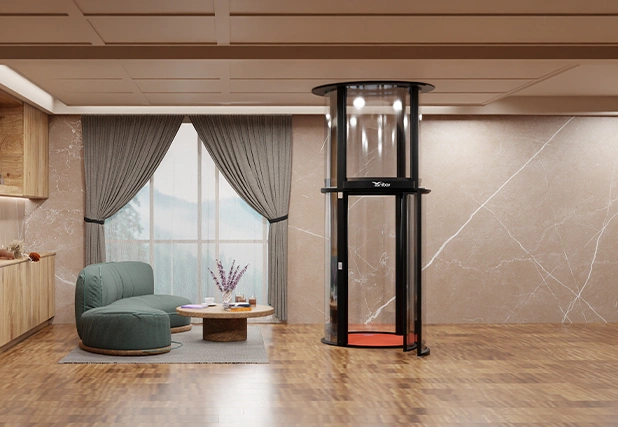
When homeowners search for lift companies near me, they are not just looking for a nearby supplier. They are looking for a trusted partner who can provide a safe, technically sound, and long-lasting vertical mobility solution for their home. Across India, multi-storey houses such as duplexes, villas, and G+2 or G+3 homes are becoming increasingly common due to rising land costs and urbanisation. As a result, home lifts are no longer considered luxury upgrades but essential lifestyle and accessibility solutions.
Choosing the right home lift depends on more than aesthetics or brand name. It requires careful evaluation of technical performance, safety systems, energy efficiency, and overall lift price for home installation. A properly selected residential elevator should support vertical travel heights up to approximately 13,500 mm, handle load capacities between 210 kg and 240 kg, and operate efficiently on standard residential electrical supply.
This guide explains how to choose the best lift company and what technical factors homeowners in India should consider before making a decision.
Table of Contents
▾- Why Searching “Lift Companies Near Me” Is Only the First Step
- What Technical Features Define a Reliable Home Lift Company
- How Lift Price for Home Is Determined in India
- Why Installation Design Should Influence Your Choice
- What Types of Home Lifts Are Available from Indian Companies
- How Energy Efficiency Affects Long-Term Costs
- How Safety Systems Separate Good Companies from Average Ones
- Why Cabin Design Matters for Daily Use
- Why Maintenance Support Is a Key Selection Factor
- How Home Lifts Influence Property Value
- How to Choose the Best Lift Company Near You
- Frequently Asked Questions
- Conclusion
Why Searching “Lift Companies Near Me” Is Only the First Step
Proximity is convenient, but technical suitability matters more. A residential lift must be designed specifically for home use, not adapted from commercial elevator systems. Home lifts must fit into limited floor space, operate quietly, and integrate with existing house layouts without requiring major structural changes.
Technically advanced home lifts use compact and self-supporting designs that eliminate the need for deep pits, reinforced shafts, or overhead machine rooms. Most modern residential lifts require only about 1,000 mm to 1,430 mm of clear floor space depending on cabin diameter. They should also be capable of precise floor alignment within millimetre tolerances to avoid trip hazards and ensure smooth entry and exit.
When evaluating lift companies near you, the focus should be on whether their products are engineered for residential use and Indian housing conditions.
What Technical Features Define a Reliable Home Lift Company
A good home lift company must offer products built for everyday residential operation. Unlike commercial elevators that prioritise high traffic loads, home lifts should focus on safety, comfort, and space efficiency.
Technically, residential lifts should support:
- Vertical travel up to three or four floors (approximately 13,500 mm)
- Load capacities of 210 kg for standard models and 240 kg for larger or wheelchair-accessible models
- Soft-start and soft-stop ride control systems
- Low-voltage control panels suitable for home electrical supply
Modern home lifts increasingly use pneumatic or compact traction systems that eliminate hydraulic oil and counterweights. This reduces mechanical complexity and lowers the risk of leakage, overheating, and long-term wear.
How Lift Price for Home Is Determined in India
The lift price for home installation varies depending on several technical and design factors rather than only the number of floors. The most important cost driver is the type of elevator technology chosen.
Pneumatic and compact residential systems reduce construction costs because they do not require pits, shafts, or machine rooms. This eliminates expensive civil work and shortens installation timelines.
Cabin size also influences price. A compact two-passenger cabin with a diameter around 750 mm to 830 mm and a 210 kg capacity costs less than a wheelchair-accessible cabin measuring approximately 1,160 mm to 1,240 mm in diameter with a 240 kg load rating.
Travel height matters as well. Systems designed for G+3 operation need taller structural components and more advanced control systems. Optional features such as cabin finishes, door styles, and lighting can add to the cost without changing the core operating mechanism.
Why Installation Design Should Influence Your Choice
Traditional elevators require weeks of civil construction, including excavation for pits, shaft building, and reinforcement beams. This is disruptive, expensive, and unsuitable for many existing homes.
Modern home lifts are delivered in modular sections and assembled on-site. Because they do not require pits or machine rooms, they can be installed directly on finished flooring. Installation is usually completed within three to five working days once the location is prepared.
From a technical standpoint, modular systems reduce reliance on wet civil work and enable faster commissioning. This makes them ideal for retrofit projects where families continue living in the house during installation
What Types of Home Lifts Are Available from Indian Companies
Most residential lift companies in India offer three main types of systems.
Hydraulic lifts use oil-driven pistons and require pits, machine rooms, and reinforced shafts. They generate heat and require periodic oil replacement, increasing long-term maintenance needs.
Traction lifts use cables and counterweights. They need shaft construction and overhead clearance and are typically more suited to commercial buildings.
Pneumatic lifts use air pressure differences to move the cabin vertically inside a cylindrical structure. These systems eliminate oil, pulleys, and counterweights. They typically require between 1,000 mm and 1,430 mm of clear floor space and are self-supporting. Their compact footprint makes them well suited for Indian homes with limited space.
How Energy Efficiency Affects Long-Term Costs
Energy consumption is a major factor when evaluating lift price for home ownership over time. Pneumatic home lifts typically use around 3.7 kVA of electricity during upward travel and consume no power during descent, relying on gravity-assisted motion.
This makes them compatible with standard single-phase residential electrical supply. Hydraulic systems, by contrast, require continuous motor operation and generate heat through oil compression, leading to higher running costs.
Energy-efficient systems reduce electricity bills and minimise mechanical stress, increasing component life.
How Safety Systems Separate Good Companies from Average Ones
A reliable lift company must provide elevators with multiple independent safety layers. These should include dual braking systems, door interlocks, and smart overload sensors calibrated to the rated capacity of 210 kg or 240 kg.
Emergency descent systems should allow the cabin to return safely to the lowest floor during power failure without requiring external backup generators. Precision landing technology must ensure floor alignment within 1–2 mm to reduce fall risk.
Cabins should be constructed using high-strength, impact-resistant panels that improve visibility and passenger confidence while maintaining structural durability.
Why Cabin Design Matters for Daily Use
Cabin size directly affects practicality. Smaller cabins around 749 mm to 830 mm suit homes with narrow staircases and limited floor area. Larger cabins measuring approximately 1,160 mm to 1,240 mm allow wheelchair access and caregiver movement.
Platforms engineered for 210–240 kg loads ensure stable transport of people, groceries, and luggage. Transparent cylindrical cabins allow light to pass through, preventing visual bulk and preserving openness in compact interiors.
Why Maintenance Support Is a Key Selection Factor
Choosing lift companies near me is only beneficial if they offer long-term service support. Technically, pneumatic systems have fewer moving parts than hydraulic lifts, reducing maintenance frequency.
A reliable company should provide periodic system diagnostics, pressure calibration checks, and brake inspections. Digital controllers should be capable of logging operational data to support predictive maintenance.
Good after-sales service ensures consistent safety performance and protects your investment.
How Home Lifts Influence Property Value
Homes equipped with residential lifts are increasingly viewed as future-ready. Technically, lifts that do not alter structural beams preserve building integrity and simplify resale.
Properties with lifts support aging in place, wheelchair access, and child safety. This makes upper floors fully usable living spaces rather than restricted zones.
In competitive real estate markets, this significantly improves resale appeal.
How to Choose the Best Lift Company Near You
The best lift company should specialise in residential elevators rather than adapting commercial models. They should conduct site assessments that measure clear floor space, ceiling height, and electrical capacity.
A professional company will recommend systems engineered for 210–240 kg capacity, up to 13,500 mm travel height, and modular installation. They should also offer documentation on safety standards, maintenance plans, and warranty coverage.
In India, Nibav Home Lifts focuses on pneumatic home elevator systems designed specifically for residential environments and Indian housing layouts.
Frequently Asked Questions
1.Why are Nibav home elevators suitable for multi-story homes in India?
Nibav home elevators use pneumatic technology with no pit or machine room, making them suitable for compact Indian multi-story houses.
2.What affects the lift price for home in India?
Lift price for home depends on model type, cabin size, travel height, customization, installation complexity, and ongoing maintenance and energy consumption costs annually.
3.What safety features do modern home elevators include?
Modern home lifts include dual brakes, door interlocks, overload sensors, emergency descent, and precise leveling within millimeters for daily residential safety and reliability.
4.How long does installation of a home lift take?
Most residential elevators are installed within 28-48 working hours using modular components, avoiding pits, shafts, machine rooms, and prolonged civil construction work indoors.
5.Why choose lift companies near me instead of distant suppliers?
Choosing lift companies near me ensures faster site surveys, compliant installation, quicker service response, and better alignment with local building regulations and permits.
Conclusion
Searching for lift companies near me should always involve technical evaluation rather than convenience alone. A modern home lift must meet residential standards for load, height, safety, and energy efficiency.
Understanding lift price for home installation requires assessing system type, cabin size, and long-term service needs rather than focusing only on upfront cost. Pneumatic home lifts stand out for their compact design, low civil work requirements, and efficient operation.
For Indian homeowners seeking reliable and future-ready vertical mobility, choosing the right lift company is an investment in accessibility, safety, and long-term living comfort.