 By shanmugapriya on October 8, 2026
|
By shanmugapriya on October 8, 2026
|



Leading Lift Manufacturers in India: What Makes a Home Elevator Brand Worth Choosing?
Choosing among lift manufacturers in India can quickly become confusing. Large global companies, Indian manufacturers and specialist home-lift brands may all appear in search results, yet they do not necessarily build the same type of elevator for the same customer. A homeowner buying a lift for a villa needs different answers from a commercial developer specifying a high-rise system. The real problem is not finding the longest list of brands; it is knowing how to judge the right one. Look at residential specialisation, technology, safety evidence, installation requirements, service support, capacity, customisation and total ownership cost. Once those criteria are clear, the shortlist becomes much easier to manage.
Table of Contents
▾- What Does a Leading Home Elevator Manufacturer Actually Mean?
- Home Elevator Manufacturers in India: The Criteria That Matter
- Residential Elevator Manufacturer vs Commercial Lift Company
- How to Compare Home Lift Brands Without Getting Misled
- Home Elevator Cost in India: Why Quotes Differ
- Nibav Home Lifts: A Specialist Residential Approach
- Nibav Models and What They Are Designed to Offer
- Nibav Home Lifts: Model Guide
- Frequently Asked Questions
- A Practical Next Step
What Does a Leading Home Elevator Manufacturer Actually Mean?
For a home elevator buyer, leadership should not be defined only by company size or commercial installed base. A strong residential manufacturer should understand private-home constraints: limited space, retrofit requirements, different interior styles, lower traffic volumes and family accessibility. Current Indian buyer research shows that homeowners comparing residential elevators, architects, builders and families seeking accessibility are key audiences. The right manufacturer therefore depends on the application, not simply the largest market presence.
Home Elevator Manufacturers in India: The Criteria That Matter
Residential focus: does the company design specifically for private homes, or is the product mainly adapted from commercial equipment?
Technology: understand whether the system is pneumatic, hydraulic, traction, machine-room-less or another architecture, and what that means for your home.
Installation: ask about pits, shafts, machine rooms, structural changes, lead time and disruption.
Safety: look for documented safety features, testing and relevant certification rather than vague claims.
After-sales service: check service coverage, maintenance schedules, spare parts and warranty terms.
Design flexibility: cabin size, doors, finishes and controls matter when the lift becomes part of a private residence.
Residential Elevator Manufacturer vs Commercial Lift Company
A commercial elevator company may have impressive engineering depth and a large service network, but that does not automatically make its system the best fit for a private villa. Residential buyers should ask whether the product is designed around home-scale traffic, compact footprints and retrofit conditions. A specialist home elevator manufacturer may offer a different technology or installation model that better matches these constraints. Conversely, a larger manufacturer may appeal to buyers who prioritise established infrastructure. The key is to compare like with like.
How to Compare Home Lift Brands Without Getting Misled
Create a standard comparison sheet before requesting quotations. Record the model, capacity, stops, cabin dimensions, power requirement, pit and machine-room requirements, installation scope, warranty, maintenance terms, certification and total price. Ask each supplier to quote the same number of stops and a similar cabin requirement. This turns a marketing-led comparison into an engineering-led decision and makes it easier to identify whether a lower headline price excludes installation or customisation.
Home Elevator Cost in India: Why Quotes Differ
Residential elevator prices vary because the equipment is only part of the project. Cabin size, number of floors, doors, controls, finishes, structural work, electrical requirements and site access can affect the final amount. Buyers should also consider maintenance and energy consumption. A transparent manufacturer should explain what is included and what is optional. For premium homes, compare the complete installed configuration rather than a starting price.
Nibav Home Lifts: A Specialist Residential Approach
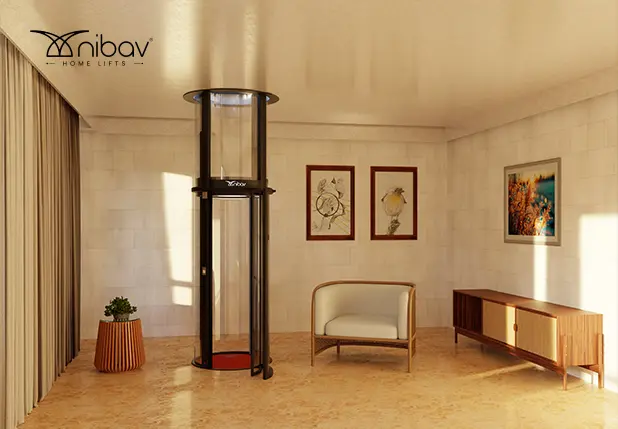
Nibav Home Lifts specialises in air-driven pneumatic residential elevators. Its India range is designed around self-supporting structures that do not require a conventional pit or machine room, according to current product information. The brand positions its technology for new and existing homes, with panoramic cabins, compact footprints and model options for different capacity and accessibility requirements. Nibav’s manufacturing operations are currently listed with ISO 14001:2015 and ISO 45001:2018 certifications, with TÜV NORD certification for its Standard model.
Nibav Models and What They Are Designed to Offer
The six-series range gives homeowners a choice from compact to premium configurations. Series III Standard focuses on compact residential use, while Series III Max adds capacity and wheelchair-friendly design. Series IV and IV Max add space and smart features. Series V and V Max emphasise premium design, with features such as HeartLine™, SkyMark™, AutoGlide™ and SmartConnect™ depending on model. Supplied pricing for this project ranges from ₹11,99,000 to ₹26,09,000, excluding applicable taxes.
Nibav Home Lifts: Model Guide
| Model | Positioning | Key details |
| Series III | Entry residential model | 210 kg; compact; up to 4 stops |
| Series III Max | Higher-capacity compact model | 240 kg; wheelchair-friendly |
| Series IV | Smart compact option | Panoramic; air-powered; smart controls |
| Series IV Max | Spacious accessible model | Up to 240 kg; 4 stops |
| Series V | Premium design model | HeartLine™, SkyMark™, AutoGlide™ |
| Series V Max | Premium accessibility model | Wheelchair access with attendant; SmartConnect™ |
Frequently Asked Questions
Who should compare home elevator manufacturers in India?
Homeowners, architects, builders and families planning accessibility should compare residential manufacturers before selecting a lift.
What should I ask a lift manufacturer before buying?
Ask about technology, capacity, stops, footprint, pit and machine-room requirements, safety systems, certification, installation, warranty, maintenance and the complete installed price.
Are specialist home lift manufacturers better than large commercial brands?
Not automatically. The better choice depends on the home, required capacity, installation constraints, service expectations and budget.
How much does a Nibav home lift cost?
The supplied India pricing used here ranges from ₹11,99,000 to ₹26,09,000, excluding applicable taxes.
How many floors can Nibav home lifts serve?
Depending on the model, the Nibav range can serve up to four stops, or G+3.
A Practical Next Step
A manufacturer is worth choosing when its product, installation method and service model fit the home you actually have. Shortlist on evidence, then invite the strongest candidates for a site assessment.
Author
No comments yet.