 By shanmugapriya on October 8, 2026
|
By shanmugapriya on October 8, 2026
|



External Elevators for 2nd Floor Homes: A Smart Solution Without Major Renovation
Adding an elevator to an existing home can feel like a construction problem before it becomes a mobility solution. There may be no shaft, no pit, no spare indoor room and no desire to break finished floors or walls. For a homeowner who only needs reliable access to a second floor, a full conventional lift project can seem disproportionate. That is why external elevators for 2nd floor searches often come from people renovating an existing house, planning for aging parents or making a two-storey home easier to use. The right solution starts with the building itself: available footprint, landing points, headroom, electrical supply and the amount of civil work the homeowner is willing to undertake.
Table of Contents
▾- Why Homeowners Consider an Exterior Lift for the Second Floor
- External Home Elevator vs Internal Lift
- Outdoor Home Lift Installation: What Needs to Be Checked
- Lift for Existing Homes: How Retrofit Planning Works
- External Elevator Cost for a Second Floor
- Nibav Home Lifts for Existing Homes
- Choosing a Nibav Model for a Two-Storey Home
- Nibav Home Lifts: Model Guide
- Frequently Asked Questions
- A Practical Next Step
Why Homeowners Consider an Exterior Lift for the Second Floor
An external lift can solve a basic retrofit challenge: the elevator does not necessarily have to occupy living space. Depending on technology, a lift can be positioned along an outside wall, balcony or another suitable area and connect to the required landings. This is useful when the interior floor plan is finished or heavily used. The audience includes independent-house owners, families planning senior-friendly homes, homeowners renovating older properties and architects looking for less disruptive retrofit strategies.
External Home Elevator vs Internal Lift
The best location is determined by the home’s geometry. An internal lift may provide better weather protection and a direct route between rooms, while an external installation can preserve more interior floor area. Buyers should compare landing access, privacy, weather exposure, drainage, electrical routing, maintenance access and the visual impact on the facade. An exterior installation is not automatically easier; the site still needs professional assessment.
Outdoor Home Lift Installation: What Needs to Be Checked
Landing alignment: the lift should stop where users can enter and exit naturally without awkward thresholds.
Foundation and floor condition: the installation surface must suit the selected system and loads.
Weather exposure: outdoor placement requires attention to drainage and durability of finishes and electrical components.
Headroom and travel: the available vertical height must match the lift’s operating requirements.
Power and access: electrical supply and maintenance access should be planned before installation.
Lift for Existing Homes: How Retrofit Planning Works
Retrofit projects benefit from a site-first process. A professional installer should measure each level, identify the intended stops, inspect the proposed installation area and determine whether structural changes are required. The homeowner can then compare cabin sizes and door arrangements against actual circulation patterns. This reduces the risk of choosing a lift that fits on paper but makes everyday access difficult. For occupied homes, installation time and disruption should also be discussed before ordering.
External Elevator Cost for a Second Floor
The cost of a second-floor lift depends on stops, capacity, technology, cabin dimensions, site conditions and finishing choices. A simple two-stop requirement can cost less than a larger multi-floor system, but the final quotation should include installation and clearly identify taxes and optional features. Homeowners should also consider long-term servicing, power consumption and warranty coverage. Comparing only the initial equipment price can hide important differences between technologies.
Nibav Home Lifts for Existing Homes
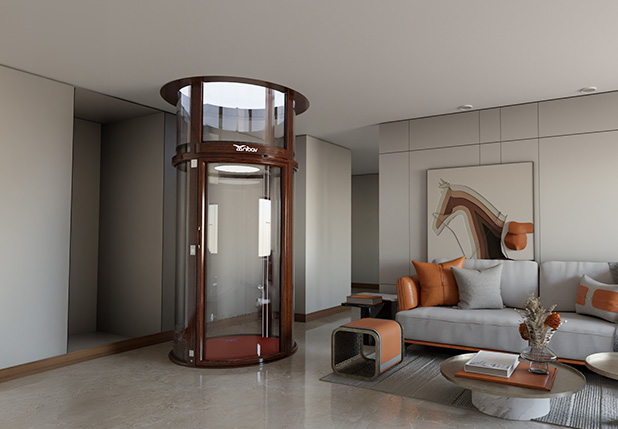
Nibav Home Lifts offers pneumatic residential elevators designed around a self-supporting structure. Its current product information states that the lifts require no conventional pit or machine room and can be considered for new or existing homes, subject to site feasibility. The technology uses controlled air pressure rather than hydraulic fluid. This can be relevant to homeowners who want to add an elevator without building a conventional shaft through the house. Selected installations can be completed within 24–48 working hours, depending on model and site conditions.
Choosing a Nibav Model for a Two-Storey Home
For a typical G+1 requirement, homeowners can begin with Series III Standard or consider larger models where cabin space and accessibility are priorities. Series III Standard has 210 kg capacity, while Series III Max raises capacity to 240 kg and provides a wheelchair-friendly configuration. Higher series add design and technology options. The supplied India pricing ranges from ₹11,99,000 to ₹26,09,000, excluding applicable taxes.
Nibav Home Lifts: Model Guide
| Model | Positioning | Key details |
| Series III | Compact retrofit starting point | 210 kg; compact; up to G+3 |
| Series III Max | Retrofit with more cabin space | 240 kg; wheelchair-friendly |
| Series IV | Compact premium retrofit | Air-driven; panoramic; smart features |
| Series IV Max | Larger accessibility option | Wide entry; up to 240 kg |
| Series V | Design-led residential upgrade | Premium interior and door features |
| Series V Max | Large premium retrofit | Wheelchair access with attendant support |
Frequently Asked Questions
Can an elevator be installed outside an existing house?
Yes, some residential lift systems can be installed externally. The proposed location must be checked for floor access, structural suitability, weather exposure and electrical requirements.
Do external home elevators require a pit?
Requirements depend on technology. Nibav pneumatic home lifts are designed without a conventional pit or machine room, subject to site suitability.
Is an external lift good for a second-floor home?
It can be practical when interior space is limited or the homeowner wants to avoid extensive changes to finished rooms. The best arrangement depends on landing access and the building layout.
How much does an external elevator cost in India?
Pricing varies by model, stops, capacity and installation conditions. Nibav’s supplied India range is ₹11,99,000–₹26,09,000, excluding applicable taxes.
Who benefits from a second-floor home lift?
Existing-home owners, families with older relatives, people planning long-term accessibility and homeowners renovating villas or independent houses are common audiences.
A Practical Next Step
If the second floor is the only barrier, do not assume you need a large commercial-style elevator. Start with a site assessment and compare a compact residential system against the actual access problem you need to solve.
Author
No comments yet.