 By shanmugapriya on September 28, 2026
|
By shanmugapriya on September 28, 2026
|



Are Domestic Lifts Suitable for Villas and Multi-Storey Homes in Ahmedabad?
In a well-built Ahmedabad villa, the top floor is often the best part of the house — better light, quieter, the terrace beyond it. It is also, frequently, the least used, because three flights several times a day is a decision people stop making somewhere in their sixties.
The conventional fix feels disproportionate to the problem. Excavating a pit and building a shaft through a finished house means weeks of construction, floor area surrendered on every level, and a machine room found somewhere. At Bodakdev or Thaltej land values, that shaft is not a construction cost — it is a permanent write-off repeated at every floor. So the project gets deferred, and the top floor stays a storeroom.
The question worth asking is whether domestic lifts in Ahmedabad are genuinely suitable for a villa, or a compromise made for want of anything better. For most such houses the answer is yes — provided the model is specified for how the household actually lives.
Table of Contents
▾What a Domestic Lift Handles — and Where It Doesn’t Fit
Domestic lifts are engineered specifically for residential use, and it’s worth being clear about both sides of that.
What they handle comfortably. Two to three passengers, repeated daily trips, across up to four stops. Capacities run 210 kg for compact cabins and 240 kg for wider ones. Travel heights reach around 13,500 mm, covering a G+3 villa with room to spare. Ride quality is smooth and quiet at around 55 dB.
Where they are the wrong specification. Moving 500 kg, or a cabin large enough for several people plus goods, or serving eight floors — these are traction and hydraulic territory. A domestic lift is not a scaled-down commercial elevator, and shouldn’t be bought as one.
For an Ahmedabad villa of two to four levels carrying a family, those limits rarely bind. The advantages, meanwhile, apply daily.
Choosing the Right Model for a Villa
| Model | Capacity | Internal cabin | Clear space | Space efficiency | Best suited to | Starts at* |
| Series III Standard | 210 kg | 749 mm | ~1,010 mm | — | Compact retrofits, tight placements | ₹11,99,000 |
| Series III Max | 240 kg | 1,160 mm | — | — | Wheelchair access on a moderate budget | ₹14,99,000 |
| Series IV | 210 kg | 830 mm | 1,000 mm | 72% | Mid-sized villas, better finish | ₹16,69,000 |
| Series IV Max | 240 kg | 1,240 mm | 1,430 mm | 77% | Larger villas, constant daily use | ₹19,69,000 |
| Series V | 210 kg | 830 mm | 1,000 mm | 72% | Design-led homes, tighter footprint | ₹19,49,000 |
| Series V Max | 240 kg | 1,240 mm | 1,430 mm | 77% | Large villas, wheelchair access, flagship | ₹22,49,000 |
*Starting rates, excluding applicable taxes, and subject to variation based on customisation, floor configuration and installation requirements. All models serve up to 4 stops (G+3) across 13,500 mm and require no pit or machine room.
For a villa specifically, two lines matter most.
Capacity. It’s about simultaneous occupancy, not household size. If two or three adults habitually travel together — the norm in a joint or business family — the 240 kg Max variants with 1,240 mm cabins are the correct specification, not the compact models.
Space efficiency. Return on space runs 72% on standard models and 77% on Max variants. In a villa, floor area isn’t scarce in absolute terms but it is expensive, so converting more of the footprint into cabin is worth paying for.
How a Lift Sits Within a Finished Villa Interior
For this audience the aesthetic question isn’t secondary — a blank metal box in a resolved interior is a genuine objection, and a reasonable one.
Four design decisions determine whether the lift integrates.
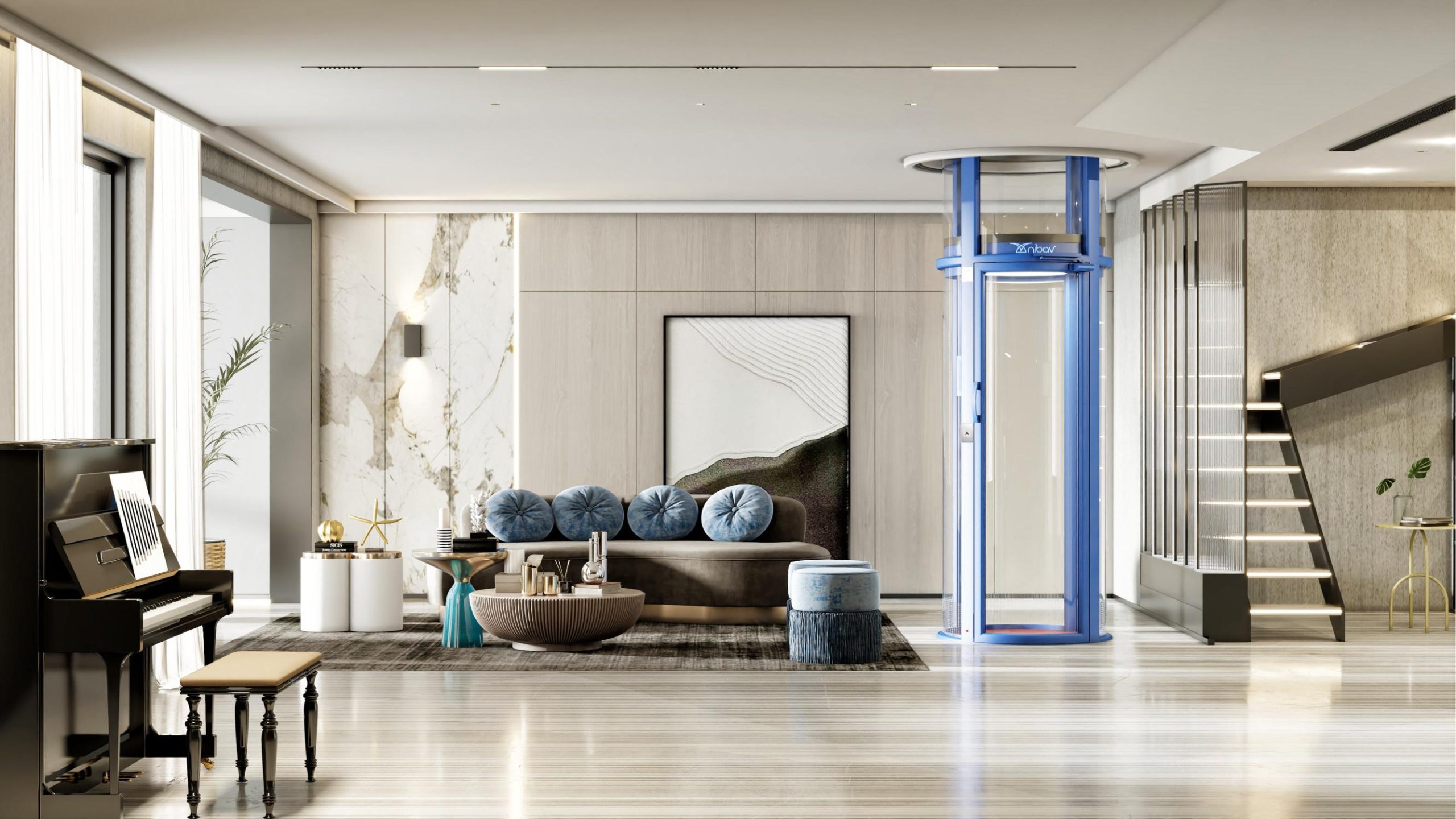
Transparency. A panoramic polycarbonate cabin and shaft keeps sightlines open through a double-height entrance or stairwell void rather than blocking them with an opaque column. In many Ahmedabad villas this alone decides placement.
Concealed hardware. Visible screws, rivets and sensor housings are what make equipment read as equipment — more obvious still behind a transparent wall. ZeroTrace™ engineering conceals them behind sculpted panels, with a springless cabin bottom and laser-cut covers continuing the logic.
Door behaviour. Manual landing doors are the clearest tell in a premium interior. Sensor-operated AutoGlide™ doors open as you approach, and GlideWide™ provides the widest opening in its class — which serves accessibility and looks better doing it.
Materials and finish. More than 20 colour and finish combinations across standard, textured, metallic and hydro editions, eight leather finishes, New Zealand wool carpeting, leather-wrapped handrails, the illuminated SkyMark™ ceiling and HeartLine™ engraving of a family name or monogram.
If you’re working with an architect or interior designer, bring the lift into the conversation early — finish selection, door orientation and access patterns are far easier to coordinate at scheme stage than after the interiors are set.
Why the Engineering Suits Ahmedabad Homes
Design is why villa owners look. Engineering is why they commit.
No pit, no machine room, no load-bearing shaft. The structure is self-supporting and transfers no load into your walls, columns or beams — which also means no structural alteration, a practical consideration in Gujarat’s seismic context. Nothing is excavated.
Installation without a construction site. Units arrive Completely Knocked Down and are assembled rather than built, typically within 24 to 48 working hours. For an occupied villa, or one finishing an interiors programme, that difference is decisive.
Low running cost. Single-phase supply drawing around 3.7 kVA while ascending and effectively nothing on descent — no three-phase upgrade needed. With no cables, counterweights, pulleys or hydraulic fluid, and grease-less engineering, servicing stays light.
Durability through temperature extremes. Aluminium and galvanised steel with a polycarbonate cabin, materials chosen to hold their finish through Ahmedabad’s summers.
Certified safety. TÜV NORD certified and built to comply with European safety standards, with ISO 14001 and ISO 45001 manufacturing certification. Automatic descent on power failure, emergency landing switch, Sure Stop, door interlocks, Smart Overload Alert, child switch and Stationary GSM communication are standard.
Relocatable. The CKD design allows dismantling and reinstallation if you move.
Seeing It Before You Specify
Two steps, in this order.
Ride the models. Standing in a 749 mm cabin and then a 1,240 mm one settles the capacity question, and a minute inside a Series V settles the aesthetic one. Nibav operates 40+ experience centres across India within a 55+ global network.
Book a site feasibility visit and request the written report. An engineer confirms whether your layout, headroom and supply take the unit as it stands, and gives your architect firm dimensions to work to.
Frequently Asked Questions
1. Are domestic lifts suitable for large villas in Ahmedabad?
Yes, provided the model matches actual use. For a villa where two or three adults travel together daily, or a wheelchair is involved, choose a 240 kg Max variant with a 1,240 mm cabin. Domestic lifts serve up to 4 stops across 13,500 mm, which covers a G+3 villa comfortably.
2. How many floors can a domestic lift serve in a villa?
Up to four stops (G+3), with a maximum travel height of 13,500 mm. Ask whether additional stops can be added later if you plan to extend upward.
3. Will a lift look out of place in a finished villa interior?
Not if it’s specified properly. A panoramic polycarbonate cabin keeps sightlines open, ZeroTrace™ engineering conceals every screw and rivet, sensor-operated doors remove the manual-door tell, and over 20 colour and finish combinations allow it to be matched to the scheme.
4. Does a villa lift need a pit or machine room?
No. Nibav’s air-driven models require no pit, no machine room and no load-bearing shaft, since the structure is self-supporting. That preserves floor area on every level and avoids structural alteration.
5. Which model works for a joint family using the lift constantly?
Series IV Max or Series V Max — 240 kg capacity, 1,240 mm cabin, 77% space efficiency, and specified for daily multi-user operation. Compact models suit households where the lift is used individually.
6. How disruptive is installation in a finished or nearly finished villa?
Minimal. Components arrive pre-built in CKD form, so the work is assembly rather than construction — no excavation, no welding, no curing time and negligible debris, typically completed within 24 to 48 working hours.
Author
No comments yet.