
 By shanmugapriya on August 26, 2026
|
By shanmugapriya on August 26, 2026
|



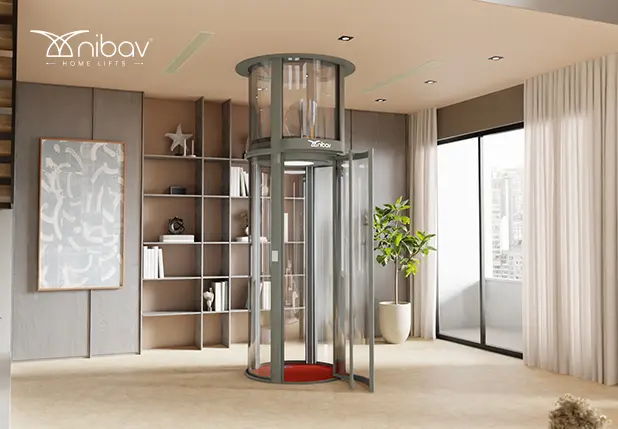
Best Small Home Elevators for Delhi Independent Houses | Complete Guide
Delhi’s independent houses are rarely short on character, but they’re often short on spare floor space — narrow plots in Vasant Kunj, tightly packed layouts in Rohini, or older constructions in South Extension that were never designed with an elevator shaft in mind. That’s usually where the idea of a lift quietly dies before it even gets a proper look, on the assumption that a small home lift in Delhi still means the same bulky footprint as a commercial elevator.
That assumption is outdated. Compact, self-supporting lift technology has changed what “small” actually means, fitting into corners and stairwells most homeowners would never have considered. This guide walks through exactly how small these systems can go, what to expect, and who benefits most from choosing one.
Table of Contents
▾- Who This Guide Is Written For
- How Small Can a Home Lift Actually Be ?
- Small Home Lift Delhi: Matching Size to Your Actual Home
- Installation in Older Delhi Properties
- Budgeting for a Small Home Lift in Delhi
- How Nibav Home Lifts Fits Delhi’s Compact Homes
- Choosing Nibav Home Lifts for a Space-Constrained Home
- Quick Answer
- Frequently Asked Questions
- 1. How small can a home lift actually be in a Delhi house?
- 2. How much does a small home lift cost in Delhi?
- 3. Can a small home lift be installed in an older Delhi property without major construction?
- 4. How many people can a small home lift carry?
- 5. How much headroom does a small home lift need?
- 6. Does a small home lift need a special power connection?
- 7. Can the lift be moved if we sell the house?
- 8. Is a small home lift suitable for narrow-plot homes in Delhi?
- Recommended Reading
Who This Guide Is Written For
This is written specifically for homeowners in Delhi’s independent houses, particularly:
- Families in narrow-plot homes across Rohini, Vasant Kunj, and South Extension where floor space is genuinely limited
- Homeowners retrofitting older properties that were never built with a lift shaft in mind
- Multi-generational households needing easier access between floors for elderly parents
- Anyone comparing compact lift options and unsure which actually fits their available space
How Small Can a Home Lift Actually Be ?
The biggest misconception homeowners carry into this research is that compact still means noticeable and disruptive. In practice, a genuinely small home lift can fit into a diametrical footprint of roughly one metre — small enough for a stairwell corner, a converted storage nook, or an unused space near an entryway.
Because the shaft is self-supporting, there’s no need for a surrounding load-bearing wall, which is often the exact detail that makes retrofitting feel impossible in a Delhi independent house built decades before lifts were common.
This compact footprint doesn’t mean a compromised experience. Even the smallest configurations typically offer a panoramic cabin design, smooth low-vibration travel, and enough room for one to two people, which covers the vast majority of daily household use.
Small Home Lift Delhi: Matching Size to Your Actual Home
Before choosing any model, it helps to measure what you’re genuinely working with rather than assuming the smallest option is always the right fit. Key things to check:
- Available floor space — most compact lifts need only around one metre of diametrical footprint
- Headroom — check clearance between your top floor ceiling and roof structure
- Structural support — self-supporting shafts don’t need a load-bearing wall, which matters significantly for retrofitting
- Daily usage patterns — solo use most days doesn’t require the same cabin size as a household that regularly moves together
Compact Model Comparison: Footprint, Capacity and Starting Price
The table below sets the Nibav range out by footprint, smallest first, so you can match a model to the space you actually have rather than working backwards from a brochure.
| Model | Clear space required | Internal cabin | Capacity | Stops | Starting price* |
| Series III Standard | ~1,010 mm | 749 mm | 210 kg (≈2 people) | Up to G+3 | ₹11,99,000 |
| Series IV | 1,000 mm | 830 mm | 210 kg | Up to G+3 | ₹16,69,000 |
| Series V | 1,000 mm | 830 mm | 210 kg | Up to G+3 | ₹19,49,000 |
| Series III Max | — | 1,160 mm | 240 kg | Up to G+3 | ₹14,99,000 |
| Series IV Max | 1,430 mm | 1,240 mm | 240 kg | Up to G+3 | ₹19,69,000 |
| Series V Max | 1,430 mm | 1,240 mm | 240 kg | Up to G+3 | ₹22,49,000 |
*Starting rates, excluding applicable taxes, and subject to variation based on customisation, floor configuration and installation requirements. All models travel up to 13,500 mm and require no pit or machine room.
Two things this table makes clear. The first three rows all sit at roughly a one-metre footprint, so if space is your binding constraint, the choice between them comes down to finish and features rather than size.
And the jump to a Max variant is a jump in footprint too — worth making only if wheelchair access with an attendant is needed now or foreseeably later, since the footprint is fixed once installed.
Installation in Older Delhi Properties
Many of Delhi’s independent houses were built decades ago, often with layouts that assumed stairs would always be the only option between floors. Retrofitting a compact, self-supporting lift into these homes typically starts with an on-site structural assessment to confirm the space works without disturbing existing walls or foundations.
Because most components arrive pre-engineered, installation itself is usually a matter of days rather than the months a traditional shaft-based system would require.
Budgeting for a Small Home Lift in Delhi
Compact two-person home lifts in India typically start from around ₹11–12 lakhs, with pricing increasing based on cabin size, number of floors served, and finish level.
Always ask providers for a full cost breakdown that separates the base unit price from installation and any optional finishes, so you’re comparing quotes on equal terms rather than bundled figures that hide where the actual differences lie.
How Nibav Home Lifts Fits Delhi’s Compact Homes
Nibav Home Lifts designs its compact range around the constraints Delhi homeowners genuinely face — narrow plots, existing layouts and limited retrofit space. Because the shaft is fully self-supporting, no machine room or dedicated pit is required, which is exactly what makes a small home lift realistic in a house never built for one. The Series III Standard, the most compact model, starts at ₹11,99,000.
Choosing Nibav Home Lifts for a Space-Constrained Home
Homeowners comparing providers for a compact lift often find that Nibav Home Lifts stands out for combining a genuinely small footprint with a panoramic, non-claustrophobic cabin, meaning the size reduction never feels like a downgrade in daily comfort. Paired with fast, self-supported installation, it’s often the practical starting point for Delhi families researching options seriously for the first time.
Quick Answer
For a compact Delhi independent house, the Nibav Series III Standard is the most practical small home elevator: a 749 mm cabin in roughly 1,010 mm of clear space, 210 kg capacity, up to G+3, fitted without a pit, shaft or machine room. Prices start at ₹11,99,000, excluding applicable taxes.
Frequently Asked Questions
1. How small can a home lift actually be in a Delhi house?
The most compact model, the Nibav Series III Standard, has a 749 mm internal cabin inside a 935 mm cylinder and needs around 1,010 mm of clear space — roughly a one-metre footprint. That makes it viable in a stairwell corner, a converted storage nook or an unused space near an entryway, none of which would take a conventional shaft.
2. How much does a small home lift cost in Delhi?
Nibav’s compact range starts at ₹11,99,000 for the Series III Standard, the smallest model at 210 kg capacity. Wider, wheelchair-accessible variants and the flagship Series V models cost more. Your final figure depends on the model, the number of floors served, cabin customisation and site requirements — all prices exclude applicable taxes.
3. Can a small home lift be installed in an older Delhi property without major construction?
Yes. Self-supporting compact lifts require no pit, no machine room and no load-bearing shaft walls, so nothing is excavated and no load is transferred into your existing structure. Retrofitting into an occupied home usually takes days rather than months, and a site feasibility visit confirms the position before you commit.
4. How many people can a small home lift carry?
The compact models are rated to 210 kg, which comfortably covers one to two adults and the vast majority of everyday household use. The Max variants step up to 240 kg with a wider cabin, which is the option to choose if a wheelchair will travel with an attendant.
5. How much headroom does a small home lift need?
Plan for roughly 2,436–2,800 mm of clearance at the top landing, depending on configuration. Headroom is the constraint that most often decides placement in an older Delhi house, so it’s worth measuring before shortlisting models — the on-site assessment will confirm it precisely.
6. Does a small home lift need a special power connection?
No. These lifts run on a single-phase supply, drawing around 3.7 kVA while ascending and effectively nothing while descending, so no three-phase provision or upgraded connection is needed — a practical advantage in older Delhi properties where electrical capacity is already committed.
7. Can the lift be moved if we sell the house?
Yes. The units are supplied in completely knocked down form and are designed to be dismantled and reinstalled at another property. Confirm the relocation charge and its effect on warranty in your agreement, since unauthorised relocation typically voids cover.
8. Is a small home lift suitable for narrow-plot homes in Delhi?
Yes — compact, self-supporting designs are specifically suited to narrow plots and tighter floor plans common across Delhi’s independent housing stock. Because the structure carries its own load, it can be placed where a conventional shaft was never an option.

Vikram
This was a very helpful guide for anyone considering a small home elevator in India. I liked how the article explains space requirements, cabin size, capacity, installation, and pricing in a simple way. The model comparison is especially useful for homeowners with limited available space. It gives a clear understanding of what to consider before choosing the best small home elevator.
Meera
A practical and informative article for homeowners planning to install a home elevator without making major changes to their existing property. The explanation of self-supporting designs and the need for no pit or machine room was particularly useful. I also found the discussion about measuring available space helpful when comparing different small home elevator options.
S Prakash
I found this guide quite useful because it covers the important factors to check before purchasing a home elevator. The information about footprint, cabin dimensions, capacity, headroom, and installation gives homeowners a better idea of what is actually required. The comparison makes it easier to understand which small home elevator could work well in a space-constrained house.
Neha
This is a well-explained article for families looking at compact home lift solutions. I particularly liked the section on older properties because many existing houses were not originally designed with an elevator. Knowing that a small home elevator can be installed with limited structural changes makes the idea much more practical for homeowners considering better accessibility and everyday convenience.
R Kannan
Very useful information for anyone researching residential elevator options in India. The article does a good job of explaining why size should not be the only factor when selecting a lift. Details about capacity, headroom, installation requirements, and pricing are helpful for comparing models. The guide gives a realistic starting point for choosing a best small home elevator based on available space.
Aditi
I really liked how this article addresses the common concern that a home elevator requires a large dedicated area. The explanation of compact footprints and self-supporting construction was easy to understand. The pricing and model comparison also add useful context for planning a budget. Overall, this is a helpful resource for families looking for a small home elevator that fits an existing house.