 By Sriram on February 25, 2026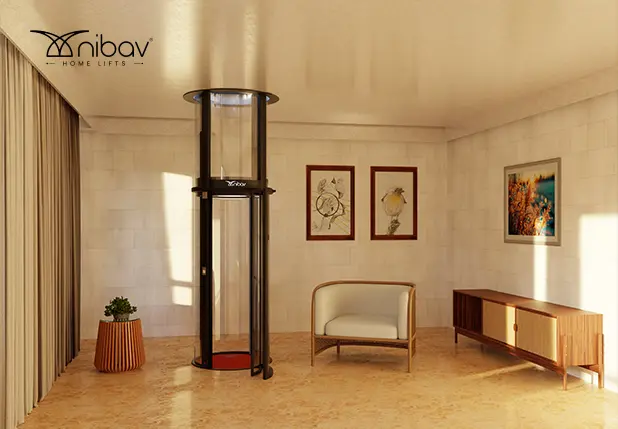
Before comparing the different types of lifts, it is important to understand what products are actually available for homeowners in India today. Residential lift requirements are very different from commercial buildings, and choosing a product designed specifically for homes makes a significant difference in safety, space usage, and long-term performance.
Nibav Home Lifts offers a complete portfolio of air-driven pneumatic home elevators, engineered exclusively for residential use. The product range includes Series III Standard, Series III Max, Series IV, Series IV Max, Series V, and Series V Max. Each series is designed for a specific home size, accessibility requirement, and design preference, while sharing the same core pneumatic technology, safety architecture, and energy-efficient operation.
All Nibav home lifts are:
- Air-driven pneumatic elevators
- Self-supporting structures
- Pit-less and machine-room-less
- Designed for up to G+3 floors (13,500 mm travel height)
- Available in 210 kg and 240 kg load capacities
With this foundation in mind, let us now explore the different types of lifts, and understand which Nibav product fits best under each requirement, supported by technical specifications.
Table of Contents
▾- What Are the Main Types of Lifts Used in Homes Today?
- Why Are Pneumatic Lifts Considered the Best Type of Lift for Homes?
- Who Should Choose Series III Standard as Their Home Lift?
- What Makes Series III Max Suitable for Accessibility-Focused Homes?
- Why Is Series IV Ideal for Modern Compact Homes?
- Who Should Opt for Series IV Max Instead of Standard Models?
- What Makes Series V a Design-Led Type of Lift?
- How Does Series V Max Redefine Premium Home Elevators?
- Where Do Pneumatic Lifts Fit Better Than Other Lift Types?
- How Do Safety Systems Differ Across Lift Types?
- Which Type of Lift Is Best for Indian Homes Overall?
- Frequently Asked Questions
- Conclusion
What Are the Main Types of Lifts Used in Homes Today?
Residential homes generally consider four types of lifts: hydraulic lifts, traction lifts, machine-room-less lifts, and pneumatic (air-driven) lifts. Each type differs in how it moves the cabin vertically and how much space and infrastructure it requires.
Hydraulic and traction lifts were originally designed for commercial buildings. They require deep pits, reinforced shafts, machine rooms, oil systems, or counterweights, making them difficult to integrate into typical Indian homes.
Pneumatic lifts, which form the core of Nibav’s entire product range, use air pressure differentials inside a sealed vertical cylinder. This allows vertical movement without oil, cables, or pulleys.
Technical snapshot (Nibav pneumatic lifts):
- Travel height: up to 13,500 mm (G+3)
- Power usage: ~3.7 kVA upward, zero power downward
- Installation: on finished flooring
- Structural requirement: none
Why Are Pneumatic Lifts Considered the Best Type of Lift for Homes?
Pneumatic lifts are designed around residential limitations such as space constraints, electrical capacity, and daily family usage. Unlike hydraulic lifts that rely on oil pressure and generate heat, pneumatic lifts rely on controlled air pressure and gravity.
Nibav pneumatic elevators eliminate:
- Hydraulic oil systems
- Counterweights
- High-stress mechanical components
This significantly reduces long-term maintenance risk and improves safety.
Technical advantages:
- Self-supporting cylindrical structure
- No pit, no shaft, no machine room
- Dual independent braking systems
Who Should Choose Series III Standard as Their Home Lift?
Series III Standard is designed for compact Indian homes where space optimization is the top priority. It suits duplex houses, row houses, and narrow stair voids without altering the home layout.
This model provides smooth daily mobility while occupying minimal floor area.
Key technical specifications:
- Load capacity: 210 kg
- Travel height: up to G+3
- Cabin: panoramic cylindrical design
- Power: single-phase residential supply
- Installation time: 3–5 working days
What Makes Series III Max Suitable for Accessibility-Focused Homes?
Series III Max is designed for homes planning long-term accessibility without moving to oversized lift systems. It is ideal for families with elderly members or wheelchair users.
This model offers increased cabin diameter while maintaining a compact footprint.
Key technical specifications:
- Load capacity: 240 kg
- Wheelchair-friendly cabin design
- Travel height: 13,500 mm
- Smart overload sensors calibrated to 240 kg
- Automatic emergency descent system
Why Is Series IV Ideal for Modern Compact Homes?
Series IV focuses on combining modern aesthetics with efficient engineering. It suits urban villas and design-oriented homes where the lift must blend seamlessly into the interior.
The 360-degree panoramic cabin enhances light flow and openness.
Key technical specifications:
- TÜV-certified safety components
- Air-driven pneumatic system
- Compact footprint with premium finishes
- Smooth start-stop ride algorithms
- Low acoustic operation
Who Should Opt for Series IV Max Instead of Standard Models?
Series IV Max is ideal for families requiring more interior space and frequent usage, while still operating within residential constraints.
It balances accessibility, comfort, and premium design.
Key technical specifications:
- Load capacity: 240 kg
- Wheelchair-compatible layout
- Wider cabin diameter
- Dual braking systems
- Precision door-locking mechanisms
What Makes Series V a Design-Led Type of Lift?
Series V elevates residential mobility into a design statement. It integrates advanced visual detailing with the same pneumatic engineering.
This series is best suited for luxury residences.
Signature technical features:
- HeartLine™ engraved panels
- SkyMark™ ceiling design
- AutoGlide™ door operation
- 25-year warranty on core parts
- Enhanced cabin vibration control
How Does Series V Max Redefine Premium Home Elevators?
Series V Max represents the most refined residential lift in the Nibav portfolio. It is built for inclusivity, elegance, and long-term reliability.
Every aspect of the cabin and motion system is optimized for comfort and safety.
Key technical specifications:
- Load capacity: 240 kg
- Wheelchair-ready spacious cabin
- Advanced pressure-regulation controls
- Emergency descent without backup power
- Silent mainboard technology
Where Do Pneumatic Lifts Fit Better Than Other Lift Types?
Pneumatic lifts can be installed in locations where traditional lifts cannot, including:
- Stair voids
- Living rooms
- Entrance foyers
- Central halls
Their transparent cylindrical structure prevents visual bulk, making them ideal for compact Indian homes.
Structural requirement: none
Civil work: zero excavation
How Do Safety Systems Differ Across Lift Types?
Nibav pneumatic lifts rely on layered safety architecture, combining mechanical and digital systems.
Safety technologies include:
- Dual independent brakes
- Door interlocks with level detection
- Smart overload sensors
- Automatic emergency descent
- Pressure monitoring systems
These systems operate continuously during every ride.
Which Type of Lift Is Best for Indian Homes Overall?
For Indian residential elevators conditions, pneumatic lifts outperform hydraulic and traction systems due to:
- Minimal space requirement
- Faster installation
- Lower maintenance complexity
- Higher energy efficiency
Nibav’s Series III, IV, and V ranges allow homeowners to select a lift based on space, accessibility, and design, without compromising safety.
Frequently Asked Questions
1.What are the main types of lifts available for homes?
Homes typically use hydraulic, traction, or pneumatic lifts, with pneumatic lifts preferred for residential spaces due to compact design and simpler installation.
2.Which Nibav lift suits small homes best?
Series III Standard suits compact homes best due to minimal space requirement, 210 kg capacity, and no pit or machine room requirement.
3.Are pneumatic lifts safe for daily residential use?
Yes, they include dual brakes, overload sensors, precision landing, and emergency descent systems engineered specifically for home safety.
4.How many floors can Nibav home lifts serve?
All Nibav home lifts support up to G+3 floors with a maximum travel height of approximately 13,500 mm.
5.Which Nibav series is best for luxury homes?
Series V and Series V Max are ideal for luxury homes due to advanced design features, premium finishes, and enhanced ride comfort.
Conclusion
Understanding the types of lifts available is essential before investing in a residential elevator. While traditional systems dominate commercial buildings, pneumatic home elevators are purpose-built for residential living.
With Series III, IV, and V product lines, Nibav Home Lifts India offers scalable solutions for compact homes, accessibility-focused families, and luxury residences alike. By combining air-driven technology, certified safety systems, and minimal structural requirements, pneumatic lifts emerge as the most practical and future-ready choice for modern Indian homes.
Author
No comments yet.